Israel Bamboo Flooring & Bamboo Decking Reviews: What Works in Mediterranean and Desert Climates

Buyers in Israel tend to ask the same two questions. Will a bamboo floor cope with the humid summers on the coast, and can a bamboo deck really survive a rooftop in July? The short answers are yes and yes, as long as the material is the right grade for the job and it goes down the right way. The longer answer is what this review is about.
Israel squeezes several climates into a small strip of land. Tel Aviv and Haifa sit in a humid Mediterranean zone where summer humidity regularly runs above sixty percent. Jerusalem sits on dry hills where winter nights drop close to freezing and apartments run heating for months. The Negev and the Jordan Valley are genuine desert, with summer temperatures above forty degrees, hard sunlight, and fine dust carried on the hamsin winds. A material that performs well across all of these zones has to handle moisture swings, strong ultraviolet light, and long dry seasons at the same time. Strand woven bamboo does this better than most timbers, but only when the floor and the deck are specified separately. What works indoors in Herzliya is not what belongs on a rooftop in Beersheba.
What the Israeli Climate Does to a Timber Floor
Every natural material installed in Israel moves, and it moves twice a year. From November to March the rains arrive and coastal air stays damp. From April to October the country dries out, and heated or air-conditioned interiors pull even more moisture out of the air inside. A solid oak or pine board absorbs and releases that moisture, swelling in winter and shrinking through summer. The results are familiar to anyone who has lived with an old timber floor here: gaps that open along the plank edges in August, boards that cup after a wet winter, and a surface that never quite looks settled.
Strand woven bamboo behaves differently because of how it is made. The raw culm is shredded into fibers, saturated with resin, and compressed into a block with a density of around 1,200 kilograms per cubic meter. That structure leaves very little room for water to move in and out, so the seasonal swelling and shrinking that ruins softer floors is reduced to a level most rooms never register. For a country where one apartment block can face sea humidity on one side and desert dryness on the other, that stability is the single biggest argument for the material.
Indoor Review: Strand Woven Bamboo Flooring in Carbonized Color
For interior floors in Israel, the recommendation is simple and consistent: strand woven construction, carbonized color, in a click or tongue-and-groove profile at 10 to 14 millimeters thick. Here is the reasoning behind each part of that specification.
Why strand woven rather than solid timber or engineered boards
The density does most of the work. A strand woven plank resists dents from furniture, heels, and the plastic feet of office chairs far better than a softwood or an engineered board with a thin oak veneer. In apartments along the coast, where beach sand gets walked in from the promenade all summer, that hard surface also takes longer to scratch and can be sanded back if it ever needs refreshing. Families with children and pets usually notice the difference within the first year.
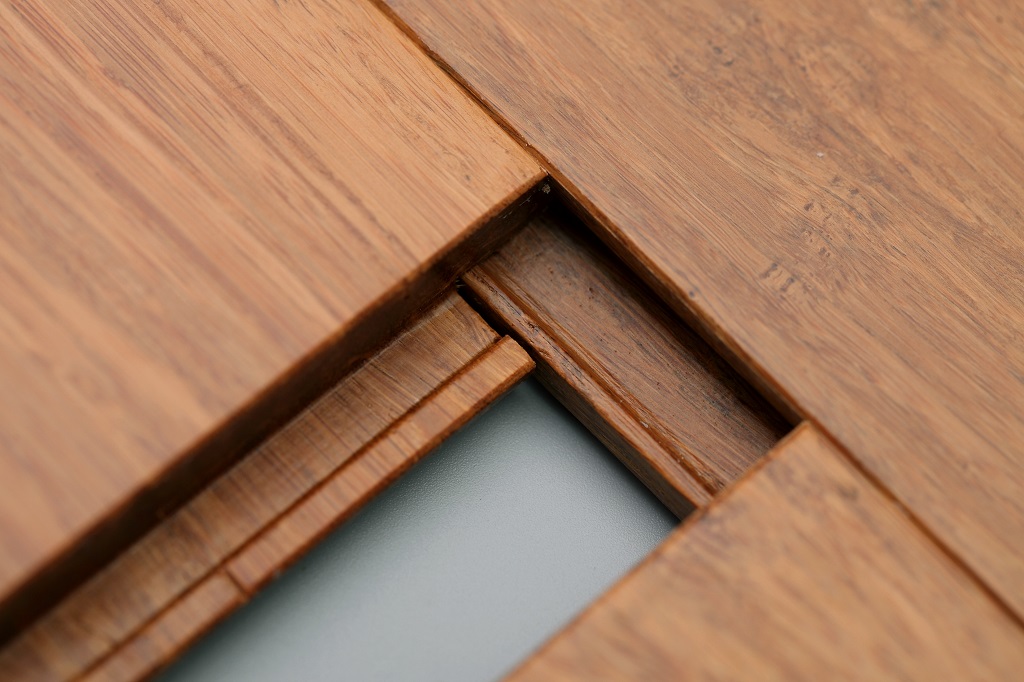
Stability matters just as much as hardness. A carbonized strand woven plank can be laid floating over an underlay, which suits the concrete slab construction used in nearly all Israeli buildings, or glued down where a heavier, quieter feel is wanted. Either way, the boards stay tight through the humid season and do not open the kind of visible gaps that solid timber shows in a dry, heated room in Jerusalem in January.
Why the carbonized color suits Israeli homes
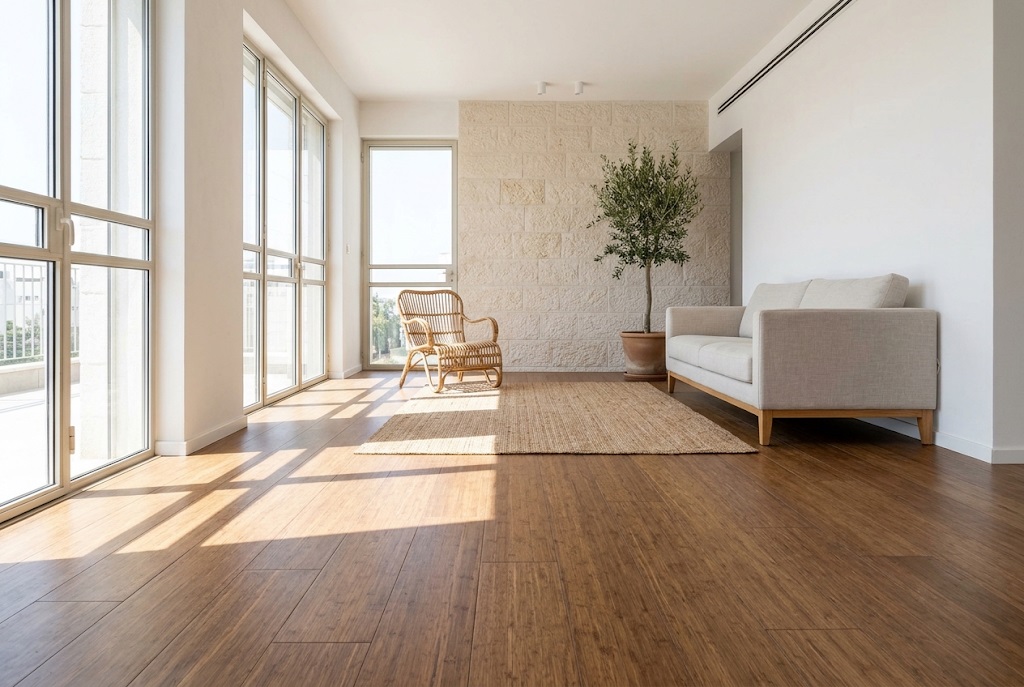
Carbonized bamboo is heat-treated during production, which darkens the fibers to a warm medium brown through the full thickness of the plank. The tone sits comfortably next to the materials Israeli interiors already use: pale Jerusalem stone, white plaster walls, terrazzo, and rattan. In the strong, low-angled light that comes through Israeli windows for most of the year, a natural pale bamboo can read almost white and show every grain of dust, while the carbonized tone stays warm and forgiving.
The heat treatment also does something structural. It breaks down a large share of the natural sugars in the bamboo and reduces how much moisture the fiber wants to hold, which makes carbonized planks even more stable than natural ones in a climate that swings between damp winters and bone-dry summers. And because the color runs through the material rather than sitting on top, a scratch or a light sanding exposes the same tone underneath instead of a pale stripe.
Thickness, finish, and underfloor heating
For most apartments, 10 or 12 millimeters is enough for a floating floor, and 14 millimeters gives a more solid feel underfoot in larger living spaces. A matte oiled finish is the better choice for the dust and sand of an Israeli home, because it can be refreshed locally without sanding the whole room, whereas a glossy lacquer shows every scratch under strong sunlight.
Underfloor heating has become common in newer Jerusalem apartments and quite a few luxury builds elsewhere, and this is where strand woven bamboo earns its place again. Its dimensional stability lets it sit over a heated slab without the gapping and checking that afflicts solid timber. If the floor is going over heating, confirm the product is rated for it and follow the warm-up schedule during the first season rather than running the system at full heat from day one.
Outdoor Review: 20mm Bamboo Decking on Rooftops and Pool Decks
Outdoor bamboo decking in Israel should be 20 millimeters thick, strand woven, and installed with a clip system over a ventilated frame. The thickness recommendation is not marketing; it comes directly from what Israeli rooftops and pool surrounds demand.
Why 20mm is the right thickness for Israel
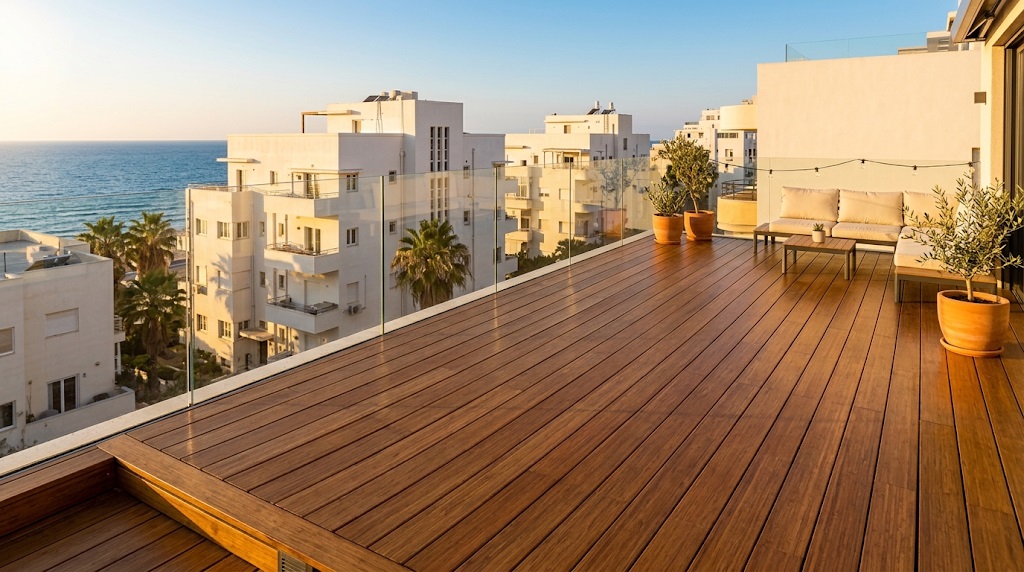
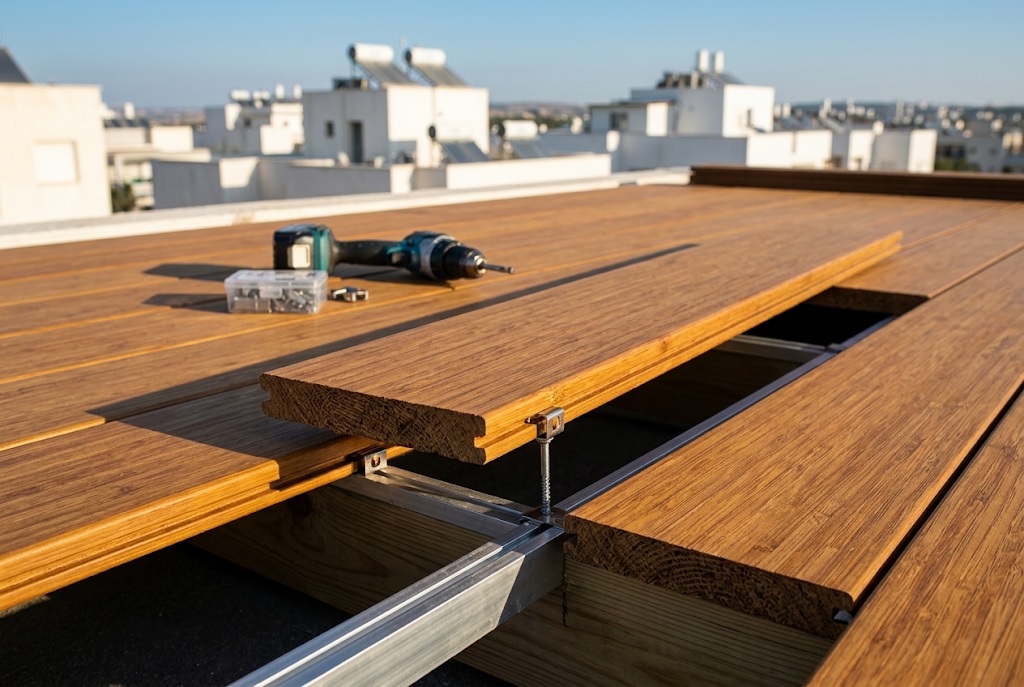
Israeli terraces are rarely ground-level gardens. They are rooftop decks on apartment buildings in Tel Aviv and Netanya, balcony decks in Haifa, and pool surrounds on villas from Caesarea to the edge of the Negev. A rooftop deck has to span joists, carry furniture, planters, and crowds of guests on a Friday evening, and do it while the surface temperature of a dark board in the July sun runs far above the air temperature. A 20 millimeter strand woven board carries that load without flexing between joists, resists cupping when one face is baked by the sun and the other sits in shade, and holds its stainless clips and screws firmly for decades.
Thinner decking exists and costs less, and it can work on a ground-level deck with closely spaced supports. On a rooftop, the price difference is small compared with the cost of lifting a warped deck off a building eight storeys up. The 20 millimeter profile also gives the board enough thermal mass to ride out the hamsin days, when a hot desert wind can swing surface conditions violently in a few hours.
Installing on a rooftop terrace
The details that decide whether a rooftop deck lasts twenty years or five are all in the frame. The structure needs a slight slope so winter rain drains instead of pooling, a clear ventilation gap under the boards so moisture from below cannot be trapped against the bamboo, and joist spacing that keeps board spans short, typically around half a meter for a 20 millimeter profile. Boards should be fixed with hidden stainless clips rather than face screws, and every cut end should be sealed with wax or end-grain oil on the same day it is cut. Before the first summer, the deck needs a proper oiling, because a well-fed board reflects heat better and weathers far more slowly than a dry, thirsty one.
Coastal versus desert weathering
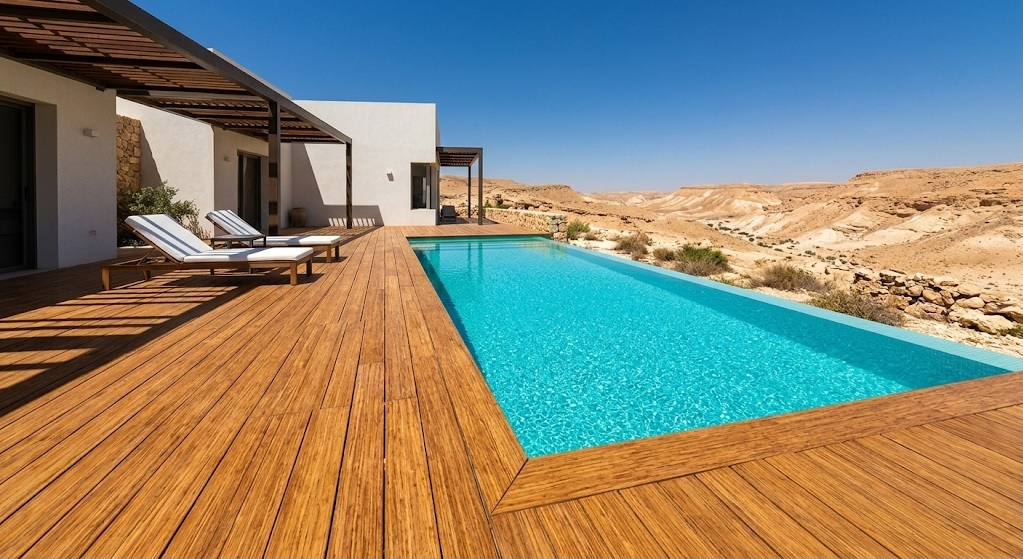
On the coastal plain, the deck faces salt air, high summer humidity, and wet winters, which makes the annual oil coat and clean drainage gaps the two habits that matter most. In Jerusalem and the desert, the enemy is different: intense ultraviolet light, extreme dryness, and swings between hot days and cool nights. A deck in Mitzpe Ramon or the Arava will grey faster and move slightly more at the ends, so a slightly wider expansion gap at the perimeter and a second oil coat before the second summer are worth planning for. In both zones, the boards grey slowly toward a silver tone if left unoiled, and many owners of desert properties actually prefer that weathered look against the landscape.
A Year of Maintenance in Israel
Through the year, the routine is lighter than most people expect. Indoors, dry mopping and entrance mats handle most of the dust and sand, and a damp mop with a neutral cleaner is enough for the carbonized floor. In heated rooms during a Jerusalem winter, a small humidifier keeps the indoor climate comfortable for people and stable for the floor at the same time.
Outdoors, spring is the season to check the deck before the dry months arrive. Clear the drainage gaps, wash the surface, look for any clip that has loosened, and apply a fresh coat of exterior bamboo oil before the first serious heat. A deck in full sun on a Tel Aviv rooftop generally wants oil once a year; a shaded or covered terrace can go two seasons between coats. The water-bead test tells you when it is time: if rain still beads on the boards, the oil is working, and if it soaks in, the deck is thirsty.
Questions Israeli Buyers Ask Before Ordering
Can bamboo flooring go over the concrete slab in a standard Israeli apartment? Yes, and that is the normal installation method, either floating over underlay or fully glued.
Is bamboo suitable for homes near the sea in Bat Yam or Herzliya? Yes. Strand woven floors handle the humidity well, and the main protection needed is an entrance mat for the sand.
Does the deck handle the hamsin? It does, provided it is 20 millimeters thick, ventilated underneath, and oiled. Extreme dry heat makes any material move a little, but strand woven decking moves far less than pine or ipe alternatives.
How does the cost compare with ipe or composite decking? Strand woven bamboo usually sits below ipe and around the level of mid-range composite, while giving a solid timber feel that composites do not. Floors compare well against engineered oak of similar hardness.
How long does shipping to Israel take? Orders are typically shipped by container through Ashdod or Haifa, and buyers should confirm lead times and import paperwork with their supplier before committing to a project schedule.
Where Each Product Fits Best
For interiors anywhere in the country, from a humidity-exposed flat in Tel Aviv to a heated apartment in Jerusalem, the carbonized strand woven floor is the specification that performs year after year. For anything outdoors, a rooftop terrace, a balcony, or a pool surround, the 20 millimeter strand woven deck is the version that stands up to Israeli summers. Ask suppliers for physical samples before ordering a full quantity, check the density and the adhesive grade on the datasheet, and insist on the oil being applied before the first summer. A bamboo product chosen this way is one of the few materials that treats the Israeli climate as a non-event rather than a lifelong argument.