Custom Bamboo Tabletop vs. Solid Wood: Best Eco Standing Desk

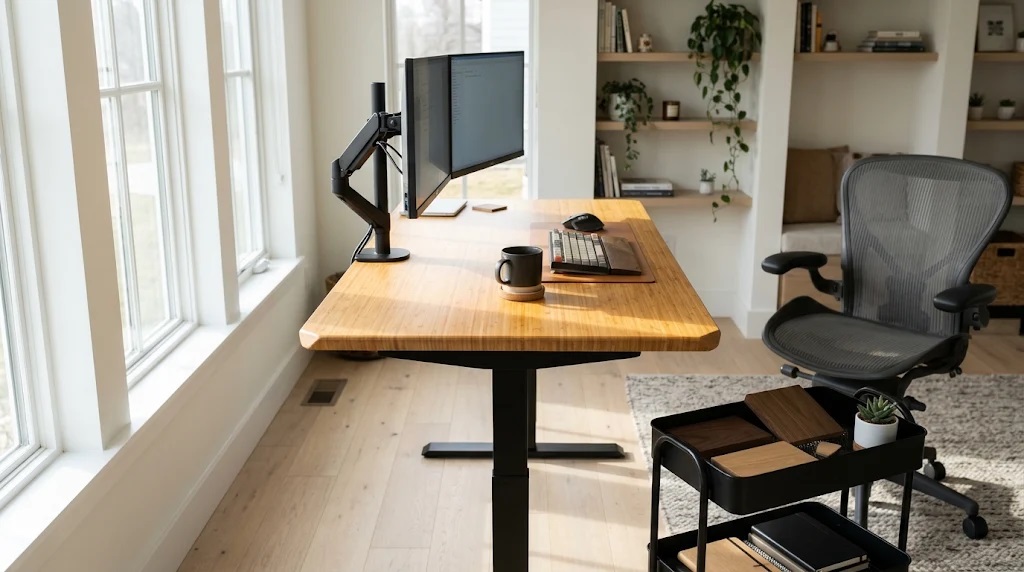
Choosing between a custom bamboo tabletop and a solid wood slab comes down to how your desk handles weight, humidity, daily wear, and budget over five to ten years of use. For most electric standing desk setups, cross-laminated bamboo offers a smarter balance of surface hardness, flat stability, moderate weight, and rapid renewability. Solid hardwood, such as American Black Walnut or White Oak, still wins for buyers who prize traditional wide-plank grain and want the freedom to sand down deep scratches decades from now.
A motorized sit-stand frame puts different mechanical demands on a desktop than a fixed four-leg writing table. Every time you raise or lower your workstation, the frame lifts the tabletop alongside your monitors, clamp arms, speakers, and laptop docks. Meanwhile, seasonal shifts in indoor heating and air conditioning constantly test whether a wide wooden panel stays flat or slowly cups. Comparing how bamboo and domestic hardwoods perform under real office conditions makes the material decision straightforward.
How Bamboo and Hardwood Are Built
Material labels alone do not tell the whole story. Two desktops can share a natural aesthetic while behaving very differently under a heavy monitor arm or inside a humid room. Understanding how each panel is engineered explains why performance diverges.
Cross-Laminated Bamboo
Architectural bamboo tabletops start with mature Moso bamboo culms split into narrow strips, kiln-dried, and milled to uniform dimensions. Manufacturers press these strips together in alternating grain directions—usually three-ply or five-ply cross-lamination—to create a rigid, balanced board. You will typically encounter three structural styles:
- Horizontal grain: Strips lie flat, showcasing the signature bamboo knuckle markings across the desk surface.
- Vertical grain: Strips stand on edge, producing a sleek, linear pattern with minimal visible nodes.
- Strand-woven bamboo: Shredded bamboo fibers are compressed under extreme heat and hydraulic pressure with low-emission resin, forming an exceptionally dense composite slab.
Because the internal layers cross each other at 90-degree angles, opposing internal tensions cancel out. That cross-ply construction is the main reason engineered bamboo desktops resist twisting without heavy metal bracing underneath.
Solid Hardwood Slabs
Solid wood desktops generally fall into two categories: wide-plank glue-ups and finger-jointed butcher block. Wide-plank tops bond full-length boards of oak, walnut, maple, or cherry edge-to-edge, displaying sweeping cathedral grain and natural color variation. Butcher block slabs join shorter, narrower timber staves end-to-end and side-by-side to reduce lumber waste and cost.
Every board in a solid wood slab runs in the same longitudinal grain direction. That natural continuity gives solid timber its classic warmth and allows woodworkers to shape organic live edges or thick bullnose profiles. At the same time, unified grain direction means the entire panel expands and contracts across its width whenever indoor relative humidity rises or drops.
Strength and Surface Hardness
Workstations take quiet punishment every day. Keyboard frames slide around, heavy ceramic mugs get set down hard, metal watch clasps drag along the front edge, and multi-monitor arms concentrate dozens of pounds onto a small clamp footprint. The Janka hardness test measures the pounds-force (lbf) required to press a 0.444-inch steel ball halfway into a material, giving buyers a reliable benchmark for dent resistance.
Everyday Dent Resistance
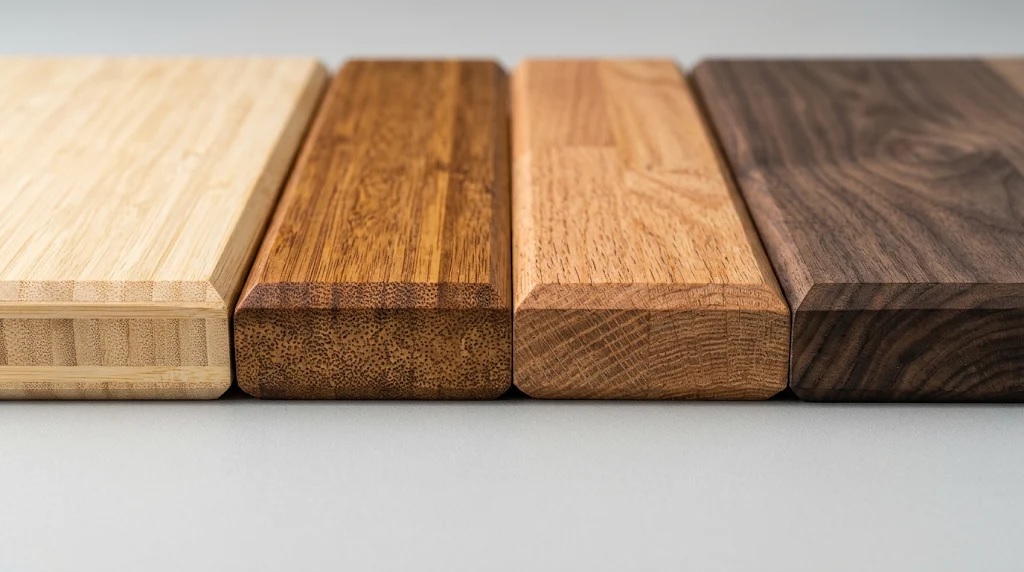
Standard solid hardwoods used for office furniture span a wide hardness range. American Black Walnut measures roughly 1,010 lbf on the Janka scale, making it noticeably softer than oak and prone to shallow impressions if you write directly on single sheets of paper with a hard ballpoint pen. Red Oak sits around 1,290 lbf, White Oak reaches approximately 1,360 lbf, and Hard Maple climbs to about 1,450 lbf.
Bamboo holds its own across the board and leaps ahead in strand-woven form. Carbonized traditional bamboo—steam-heated to achieve a warm caramel tone—tests around 1,180 lbf, sitting comfortably between walnut and red oak. Uncarbonized natural bamboo averages roughly 1,380 lbf, edging slightly past White Oak. Strand-woven bamboo jumps into another tier altogether, routinely testing between 3,000 and 4,000 lbf. That density makes strand-woven bamboo two to three times harder than White Oak and virtually impervious to accidental pen dents, dropped tools, or heavy equipment bases.
Monitor Arm Clamp Support
Clamp-mounted dual or triple monitor arms exert concentrated shear and compression forces along the rear edge of a standing desk. Thin particleboard or hollow-core honeycomb desktops frequently crush or bow under tight C-clamps.
Both solid hardwood and solid laminated bamboo handle heavy monitor clamps reliably when built to proper thickness. A 1-inch to 1.5-inch cross-laminated bamboo desktop distributes clamp pressure evenly across dense vascular fibers without compressing the core. Solid oak and maple perform just as well, though softer species like walnut or rubberwood benefit from a thin steel reinforcement plate tucked between the clamp pad and the underside of the desk to prevent surface indentations.
Stability, Weight, and Desk Frames
A standing desk only feels steady when the tabletop and steel frame complement each other. Overly heavy slabs eat into motor lifting capacity, while unstable panels rock or bow over wide spans between leg columns.
Humidity and Warping
Solid wood is hygroscopic, meaning it absorbs ambient moisture in damp summers and releases moisture during dry winter heating seasons. On a 30-inch-deep solid oak or walnut desktop, seasonal expansion and contraction can introduce subtle cupping, bowing, or hairline end-checks. Many reputable solid wood desk makers even specify that minor distortion of up to 2 millimeters is normal timber behavior and rout recessed steel C-channels underneath the top to keep the slab flat.
Cross-laminated bamboo panels respond far more predictably to changing indoor climates. Alternating grain layers lock the board in place, significantly cutting down seasonal width movement. If your home office sits in a coastal city, a basement studio, or an arid climate with aggressive HVAC cycles, a multi-ply custom bamboo tabletop offers far lower risk of warping without requiring embedded steel stiffeners.
Motor Weight Headroom
Dual-motor standing desk frames commonly carry total dynamic lifting ratings between 220 and 355 pounds, while heavy-duty four-leg commercial frames push up to 440 pounds. On many frames, the manufacturer’s rated limit includes the weight of the desktop itself.
Thick solid hardwood slabs get heavy fast. A 1.5-inch to 1.75-inch wide-plank walnut desktop can weigh roughly 6.6 pounds per square foot, placing a 60-by-30-inch slab past 80 pounds before you bolt on a monitor arm, two 32-inch displays, a desktop tower, and studio speakers. A 1-inch or 1.25-inch custom bamboo tabletop trims substantial dead weight while keeping full structural stiffness across a 60-inch or 72-inch span. Lighter desktop mass preserves lifting headroom, simplifies solo or two-person assembly, and keeps motor gears running quietly over years of daily sit-stand transitions.
Sustainability and Indoor Air Quality
Eco-friendly office furniture goes beyond marketing slogans. True environmental performance rests on two measurable factors: how quickly the raw resource regenerates in nature and what chemical emissions enter the room where you spend eight hours a day.
Fast Harvest and Regrowth
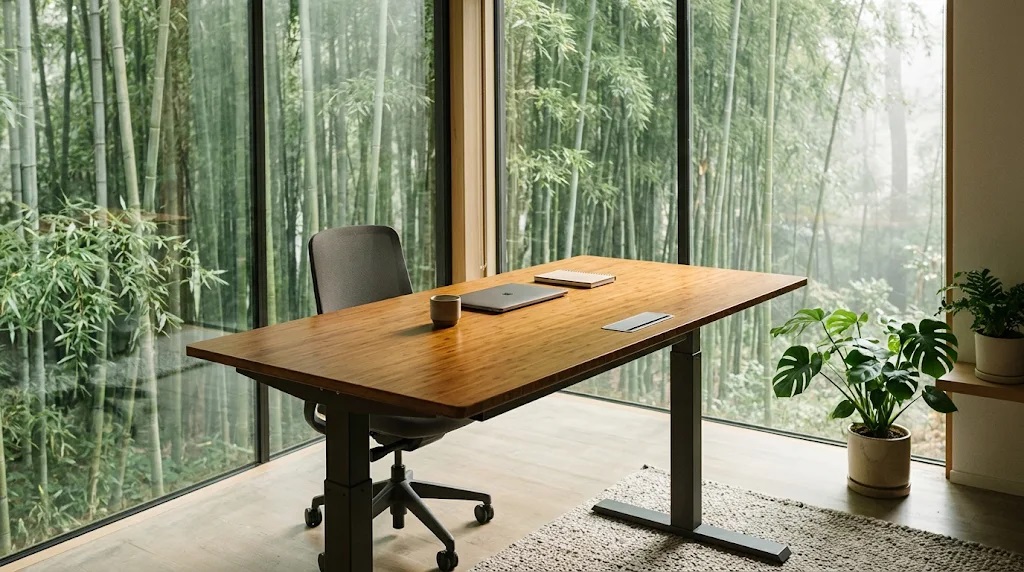
Botanically, Moso bamboo (Phyllostachys edulis) belongs to the grass family rather than timber trees. A new shoot reaches its full towering height in a single growing season, and the culm walls harden to commercial structural maturity within four to five years. Slow-growing hardwoods such as oak, maple, and walnut typically require 40 to 80 years—and sometimes longer for mature wide-plank stock—before harvest.
Equally important is what happens underground after cutting. Harvesting mature bamboo stalks leaves the subterranean rhizome root system untouched. New shoots emerge naturally the following spring without clear-cutting, soil tilling, or replanting. Selecting FSC-certified bamboo or sustainably managed domestic North American hardwood ensures the supply chain avoids illegal logging and protects native forest ecosystems.
Adhesives and Low-VOC Care
Because laminated bamboo uses adhesive between strips and plies, resin quality matters. Under U.S. federal EPA TSCA Title VI rules and California CARB Phase 2 standards, composite hardwood plywood and laminated panels are capped at a strict 0.05 parts per million (ppm) formaldehyde emission limit—substantially tighter than the 0.09 ppm cap for particleboard or 0.11 ppm limit for medium-density fiberboard.
High-grade custom bamboo tabletop producers go even further, bonding panels with No-Added-Formaldehyde (NAF) or Ultra-Low-Emitting Formaldehyde (ULEF) adhesives and sealing surfaces with UV-cured, low-VOC water-based matte coatings. Solid wide-plank wood uses minimal edge-glue seams, though its indoor air profile still depends on whether the maker applies zero-VOC hardwax oil or solvent-heavy polyurethane lacquer. Always ask suppliers for third-party emission compliance documentation regardless of which material you pick.
Daily Care, Repair, and Lifespan
Neither bamboo nor solid wood is waterproof, and both reward basic common-sense habits over decades of work. Their long-term maintenance curves differ mainly when real accidents happen.
Routine Surface Upkeep
Day-to-day cleaning for both materials requires nothing more than a lightly dampened microfiber cloth followed by a dry wipe. Harsh ammonia cleaners, abrasive pads, and standing puddles will cloud factory lacquers or swell exposed wood fibers over time. Keeping coasters under piping-hot coffee mugs and using a felt or leather desk mat under heavy mechanical keyboards protects the topcoat from thermal rings and micro-abrasions.
Sanding and Refinishing
Here is where solid wood holds an unmistakable long-term edge. If a heavy metal camera lens drops onto a solid oak or walnut desktop and leaves a deep gouge, you can sand out the damage, blend the surrounding timber, and reapply hardwax oil or satin lacquer until the spot disappears. A 1.5-inch solid wood slab can be fully refinished multiple times over a thirty-year lifespan.
Multi-ply bamboo with a thick top wear layer can also be lightly scuffed and recoated when the factory matte finish dulls after years of mouse movement. However, deep gouges—particularly in compressed strand-woven bamboo—are harder to sand smooth and color-match invisibly than uniform hardwood planks. If you prefer an heirloom piece that develops patina and accepts aggressive restoration, solid wood fits that philosophy well.
Retail Butcher Block vs. Custom Tops
Many people building a standing desk start by browsing big-box home improvement aisles before looking into custom fabrication. Both routes can produce an attractive workspace, yet the hidden labor and material differences often surprise first-time builders.
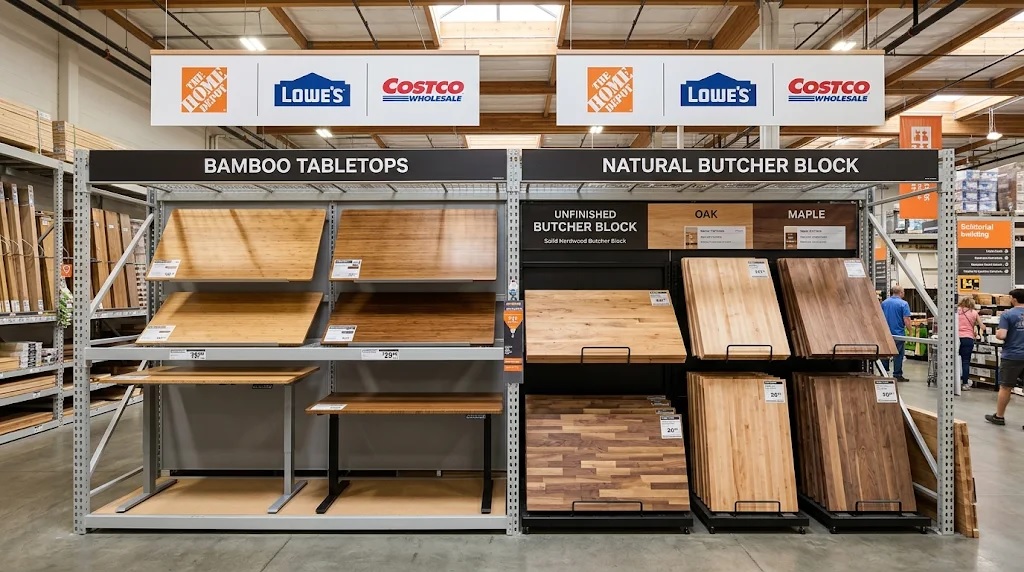
Big-Box Retail Limitations
Off-the-shelf butcher block countertops from major retailers such as Home Depot, Lowe’s, or Costco appeal to DIYers because of accessible pricing and local pickup. Still, standard retail slabs are milled for kitchen counters rather than ergonomic workstations. Most arrive in fixed lengths—commonly 48, 72, or 96 inches—at a 25-inch kitchen counter depth that can feel cramped when paired with deep monitor stands.
Many retail butcher blocks also ship completely unfinished or coated only in temporary transit oil. Turning a raw slab into an office-ready desktop requires trimming to length, routing sharp 90-degree front edges so they do not dig into your wrists, sanding through progressive grits, applying multiple coats of oil or polyurethane on both faces to prevent warping, and waiting days for finishes to cure. Additionally, budget big-box slabs often rely on softer rubberwood, birch, or acacia staves rather than dense Moso bamboo or select North American walnut.
Custom CNC Sizing Benefits
Ordering a custom bamboo tabletop directly from a dedicated manufacturer eliminates weekend woodworking chores and tailors the work surface to your exact room layout. Instead of forcing a standard 60-by-30-inch rectangle into a tight corner alcove, you can specify exact dimensions such as 54 by 28 inches or 74 by 32 inches.
Precision CNC machining adds practical office ergonomics right at the factory:
- Ergonomic front bevels: A gentle chamfered or curved contour along the typing edge relieves wrist pressure during long sessions.
- Integrated cable routing: Cleanly milled oval or round grommet cutouts match your monitor layout and hide power bricks neatly.
- Pre-installed threaded inserts: Metal machine-screw inserts allow you to bolt your standing desk frame tightly and disassemble it repeatedly during moves without stripping wood threads.
- Factory UV-cured sealing: Industrial roller-coated matte finishes cure evenly across all six sides, locking out moisture before the tabletop ever leaves the plant.
Frequently Asked Questions
Does bamboo crack over time?
Quality cross-laminated bamboo rarely cracks when properly kiln-dried to balanced moisture content and sealed on both top and bottom faces. Cracks usually appear only in cheaply pressed single-layer panels exposed to extreme dryness or direct radiator heat. Maintaining indoor relative humidity between 35 and 55 percent keeps both bamboo and solid hardwood stable for decades.
Which thickness fits best?
For most electric standing desks spanning 48 to 72 inches, a 1-inch to 1.25-inch custom bamboo tabletop strikes the ideal balance of rigidity, clamp strength, and manageable weight. If you choose solid hardwood like oak or walnut—especially across spans wider than 60 inches—step up to 1.25 or 1.5 inches and verify that your dual-motor frame offers ample lifting headroom.
Is bamboo cheaper than wood?
In most markets, a custom-finished bamboo tabletop costs noticeably less than select wide-plank American Black Walnut, White Oak, or Cherry of matching dimensions. While unfinished budget butcher block from a warehouse retailer can carry a lower sticker price up front, adding finishing supplies, sanding tools, edge routing, and labor narrows the gap quickly—often making a factory-finished custom bamboo top the stronger overall value.
Ultimately, your workspace habits should guide the purchase. Pick solid hardwood if you love expressive wide-plank wood grain, plan to oil and sand the surface yourself over decades, and pair it with a heavy-duty frame. Choose a custom bamboo tabletop if you want superior scratch resistance, rock-solid flatness in shifting humidity, lighter stress on your desk motors, and a rapidly renewable surface engineered specifically for daily sit-stand performance.