Commercial Bamboo Decking: Why Hotels and Parks Are Switching to Strand Bamboo

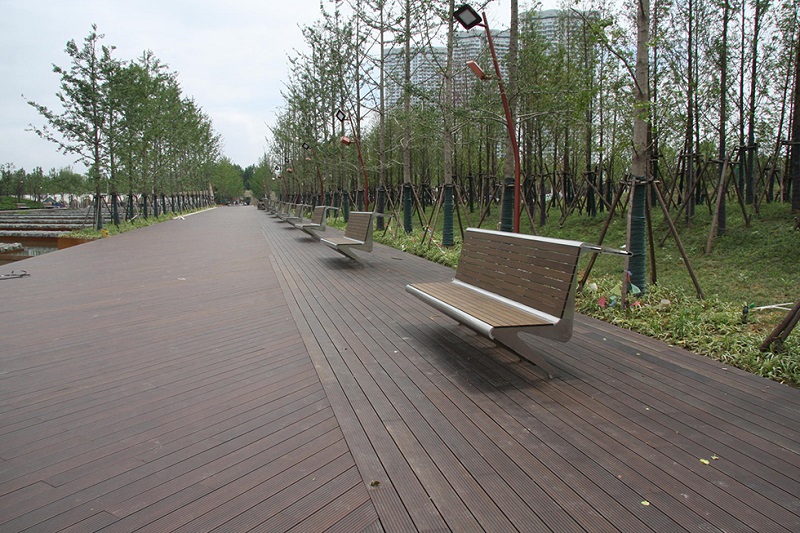
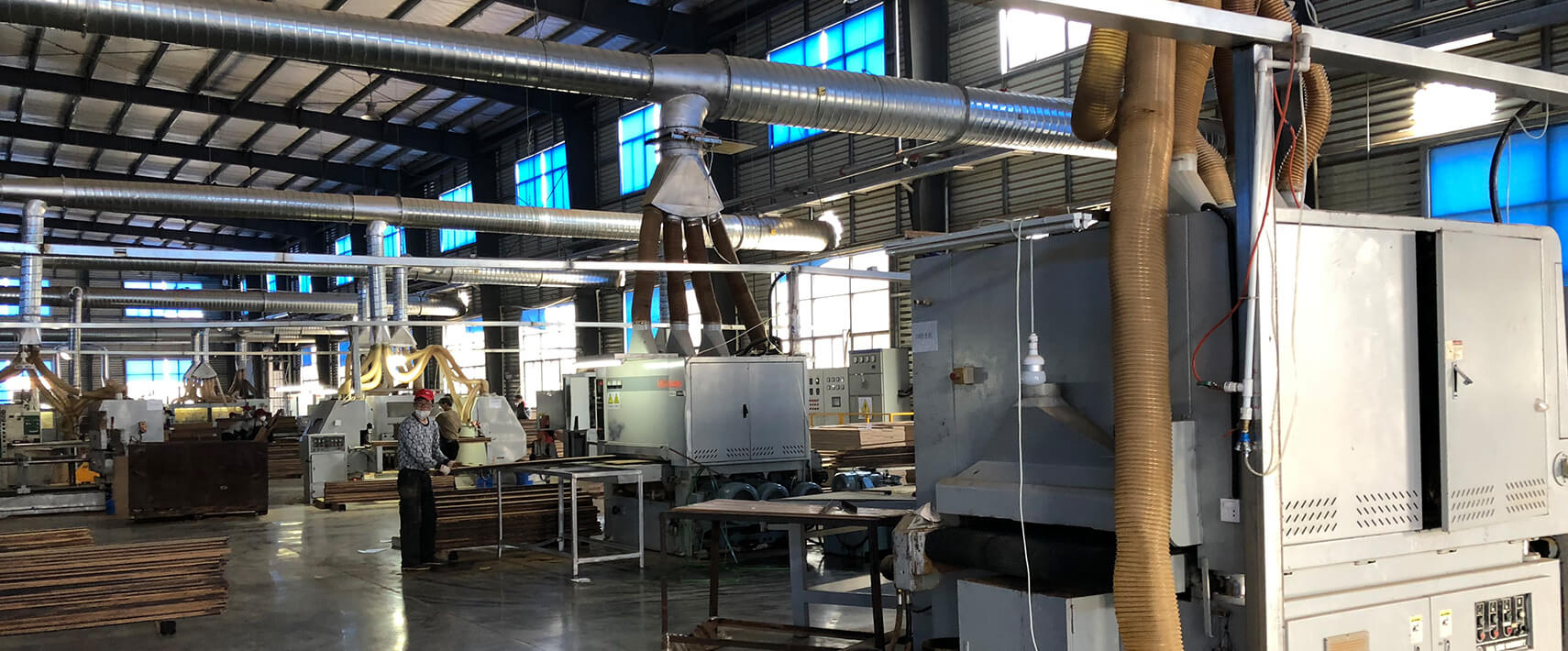
Commercial bamboo decking has moved out of the residential patio market and into hotel pool decks, resort boardwalks, marina walkways and municipal park structures. The material driving that shift is strand bamboo, also sold as strand-woven bamboo or heavy bamboo. It is not the pale, soft bamboo flooring people remember from big-box stores two decades ago. It is a dense engineered product made by shredding bamboo culms into fiber bundles, soaking them in resin, and pressing them under heat into boards that are harder than most commercial hardwoods.
For a hotel operator or a parks department, the decision comes down to a short list of practical questions. How does it hold up under thousands of wet feet a week? Does it meet fire code? Will it splinter, cup, or fade? What does it cost to keep it looking acceptable over ten years? Strand bamboo answers those questions well enough that specifiers who once defaulted to ipe, teak or wood-plastic composite are now writing bamboo into their standards.
What strand bamboo decking actually is
Moso bamboo grows to harvestable size in about five years. The culms are split, crushed into loose fiber bundles, dried, then soaked in a phenolic or modified adhesive. The soaked fiber goes into a mold and is pressed at high temperature and pressure into a dense billet. That billet is milled into decking profiles.
The difference between this and traditional bamboo plank flooring is orientation and density. Traditional bamboo flooring glues thin strips together and keeps the fiber direction visible. Strand bamboo compresses fiber in every direction, which is what produces the characteristic marbled grain and the very high density. Typical commercial strand bamboo decking lands around 1.15 to 1.25 grams per cubic centimeter. Ipe sits around 1.0 to 1.1. Oak is closer to 0.75.
Density sounds like an abstract spec sheet number until you think about what it means on a resort walkway. Denser material resists dents from furniture legs, resists the scuffing of rolling luggage, and wears down more slowly under grit tracked in from a beach or a trail. It also absorbs less water per unit of volume, which is why strand bamboo performs better in wet environments than its natural fiber origin might suggest.
Why hardness and stability matter more than looks
Specifiers usually ask for hardness first. Strand bamboo decking commonly tests above 3,000 pounds-force on the Janka scale, and some products push past 4,000. For comparison, white oak is around 1,360 and ipe is around 3,500. That hardness translates directly into fewer visible wear paths in high-traffic lanes, which is the thing hotel guests notice and facility managers get complaints about.
Dimensional stability is the quieter reason for the switch. Boards installed outdoors move with moisture. Strand bamboo, because of its resin content and compressed structure, has low water absorption and low swelling compared with solid timber. In practical terms that means fewer cupped boards, fewer popped fasteners, and less of the washboard effect that shows up on poorly specified exterior decks after two wet seasons.
There is a second benefit hotels care about: strand bamboo does not splinter the way softwood decking does. A splinter on a barefoot pool deck is a liability problem, not a maintenance problem. The compressed fiber structure tends to stay intact even as the surface weathers, which is one reason bamboo shows up around pools, spa terraces and outdoor shower areas.
Fire ratings and why hotels ask about them first
Any commercial deck attached to a hotel, restaurant or multi-unit building has to satisfy fire code, and exterior decking is often reviewed more closely than people expect. Strand bamboo can be produced to reach a Class A or B flame-spread classification under ASTM E84, and to Bfl-s1 under the European EN 13501-1 system, depending on the product and the finish.
That matters for two reasons. First, some jurisdictions restrict combustible decking on balconies and upper-level walkways, and a rated product removes an argument from the plan review. Second, insurance underwriters for resort properties increasingly ask for documentation. Being able to hand over a test report rather than a marketing claim shortens the approval process.
It is worth saying plainly: not every bamboo decking product carries the same rating, and the rating belongs to a specific board, finish and installation assembly. Buyers should ask for the actual test report number and the lab that issued it, not a brochure line.
Slip resistance around pools and water features
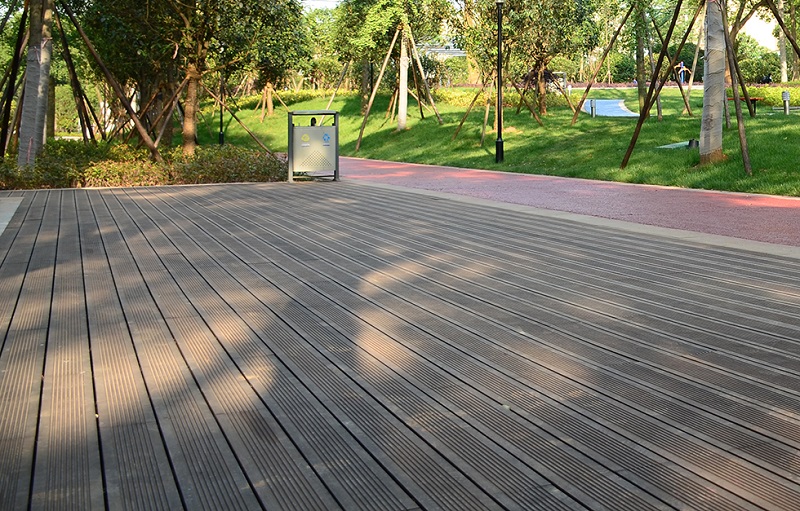
Wet slip resistance is where a lot of otherwise good decking products fail in the field. Strand bamboo decking is usually milled with a ribbed or grooved face, and the harder surface holds that texture longer than softer woods, which polish smooth under foot traffic within a couple of seasons.
Independent testing typically reports wet slip values in the R10 to R11 range under the DIN 51130 ramp test, with some profiles higher. For a pool surround, a marina ramp or a park bridge that gets rained on, that rating is the one that belongs in the specification. It is also worth checking the value for the specific profile you are buying, because a smooth-milled board and a deep-grooved board from the same manufacturer can test differently.
Parks departments add another requirement: barefoot and wheelchair traffic. A groove pattern that is too aggressive is uncomfortable and catches wheels, while a pattern that is too shallow loses grip when algae builds up in a shaded area. Most manufacturers now offer a medium groove that threads that needle, and it is worth asking for samples and walking on them wet before committing to a full order.
Span, load and how it behaves on a boardwalk
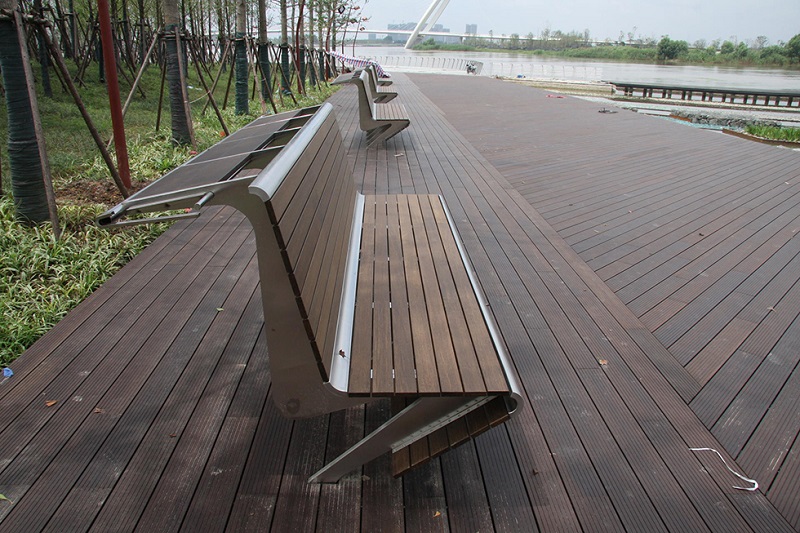
Strand bamboo is strong, but it is not a structural beam. Standard joist spacing for commercial decking is usually 400 millimeters or 16 inches on center, and many manufacturers recommend 300 millimeters or 12 inches for heavy public traffic or for diagonal installation. Ignore that and you get springiness underfoot, which reads as cheapness even when the material itself is fine.
For raised boardwalks through wetlands or dunes, the substructure matters more than the decking. Hot-dip galvanized or stainless steel framing, adequate ventilation beneath the deck, and proper drainage all extend the life of any decking material. Bamboo’s advantage here is weight: it is heavy enough to feel solid but easier to handle on a remote site than tropical hardwood, which reduces labor time on long runs.
Public park structures also deal with point loads from maintenance carts, event setups and, occasionally, small service vehicles. Strand bamboo handles concentrated loads well because of its density, but the design should still spread those loads across joists with blocking or doubling. A good shop drawing review catches this before installation, which is far cheaper than replacing boards after an event.
What weather actually does to it
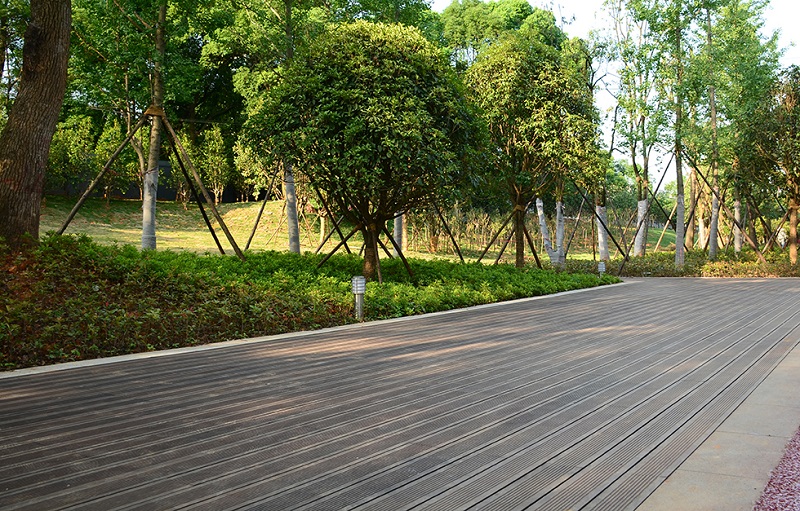
No exterior wood product stays the same color outdoors. Strand bamboo starts as a warm caramel or a darker coffee tone depending on whether it has been carbonized, and it weathers to a silver-gray within six to eighteen months if left unfinished. Some owners like that. Most hotels do not, because a graying deck next to a freshly painted building looks neglected.
The usual approach on commercial jobs is a penetrating oil finish applied once or twice a year on horizontal surfaces, more often in full sun. This is the same maintenance rhythm as hardwood decking, and it is less demanding than sanding and resealing a softwood deck every year. Composite decking needs less frequent attention but cannot be refinished to remove scratches, so the tradeoff is between routine oiling and eventual replacement.
One behavior worth knowing: bamboo decking develops fine surface checking, small hairline cracks, in very dry or very hot climates. It is generally cosmetic and does not indicate structural failure, but it is the most common reason facility managers call the supplier. Acclimating the boards on site before installation and following the manufacturer’s gapping and end-sealing instructions reduces it significantly.
Maintenance and the real cost over ten years
Initial price per square meter is the number that gets compared in bid meetings, and it is the least useful number. A better comparison is cost over a ten-year service window, including labor.
Strand bamboo decking typically sits in the middle on material cost: more expensive than pressure-treated pine and most composites at the entry level, less expensive than premium ipe or teak. Its maintenance profile is closer to hardwood: periodic cleaning, periodic oiling if you want to keep the color, occasional board replacement if something gets damaged.
Where the numbers separate is replacement cycle. Properly installed strand bamboo in a commercial setting is commonly warranted for 10 to 25 years depending on the manufacturer and application, and real-world service life often runs longer than the warranty. Pressure-treated softwood in the same location frequently needs partial replacement inside ten years. Composite generally lasts but loses its surface and cannot be restored.
For a hotel, the hidden cost is downtime. A pool deck that is closed for a week during high season costs more than the decking itself. Material that can be repaired board by board, with hidden clip systems that let a single plank come out without disturbing its neighbors, has real operational value that never shows up in a unit price comparison.
Sustainability paperwork that actually gets checked
Bamboo’s environmental story is genuinely strong, but only the documented part of it counts on a commercial project. Moso bamboo is a fast-regenerating grass that is harvested without replanting because the root system stays intact and sends up new culms. That is a real advantage over slow-growing hardwood, and it holds up in a specification review when backed by chain-of-custody certification.
For projects targeting green building credits, what matters is FSC certification for the material, low-emission adhesive documentation such as E0 or E1 formaldehyde ratings, and regional sourcing documentation if the project is chasing local-material points. Ask for the certificates with the certificate numbers, and check that the scope covers decking rather than a different product line.
There is also a procurement angle. Many hotel groups and municipal buyers now have responsible-sourcing policies that require documented legal and sustainable harvest. Bamboo with proper paperwork satisfies those policies more easily than tropical hardwood, where provenance documentation can be inconsistent.
Installation details that decide whether the deck lasts
Most bamboo decking failures trace back to installation rather than material. A few details do most of the work.
Boards should be acclimated on site in their packaging for several days before installation. End cuts should be sealed, because end grain is where water enters fastest. Expansion gaps between boards and at walls should follow the manufacturer’s specification for the local climate, and installers should not be improvising those gaps.
Ventilation under the deck is critical. Bamboo decking should not be installed directly over a solid surface with no airflow, and ground clearance should be adequate. Standing water and trapped humidity shorten the life of any wood-based product, bamboo included.
Fastening matters too. Hidden clip systems give a clean surface and make board replacement straightforward, which is what most commercial clients want. Face-screwing with stainless steel screws is acceptable and sometimes preferred on very exposed sites, but it needs predrilling near board ends to avoid splitting. Use stainless steel or hot-dip galvanized fasteners, never standard steel, and never mix metals.
Finally, keep the deck clean. Grit, sand and organic debris hold moisture against the surface and encourage mold growth. A scheduled rinse and a soft brush is more effective than aggressive pressure washing, which can damage the surface fibers.
What to ask a supplier before you specify
A short checklist keeps a specification honest. Ask for the density figure, the Janka hardness test result, the moisture content at shipping, the fire test report with the standard and lab named, the wet slip resistance rating for the exact profile, the recommended joist spacing for your application, the warranty terms and what voids them, and the FSC or equivalent certification number.
Also ask for project references in a comparable climate and use case. A supplier who has done coastal resort work can talk about salt exposure and sun exposure with specifics. A supplier who has only done residential patios may not have answers you need.
Ask about color consistency between production batches as well. Bamboo is a natural fiber product, and some variation is normal and desirable, but a large project ordered in two shipments should be checked against a control sample so that a repair section installed three years later does not stand out.
Questions hotel and park buyers keep asking
Is bamboo decking slippery when wet? Ribbed and grooved profiles generally test in a range suitable for pool surrounds and public walkways, but the rating is profile-specific. Get the test result for the board you are buying.
How long does it actually last in a commercial setting? Documented commercial installations with good detailing regularly run well past fifteen years, and manufacturers commonly back products with 10 to 25 year warranties for commercial use.
Can it be refinished? Yes. Unlike composite decking, strand bamboo can be cleaned, lightly sanded and re-oiled to restore appearance, which is a major advantage for properties that need to protect their brand image.
Does it get too hot in direct sun? All dark decking surfaces absorb heat. Lighter-toned bamboo finishes stay cooler than dark hardwoods or dark composites, which is worth considering for barefoot areas in hot climates.
What about mold and algae? Any exterior deck in a shaded, damp location will grow surface mold. Regular cleaning handles it. Bamboo’s low water absorption helps, but it is not a substitute for maintenance.
Is it suitable for coastal projects? Yes, with stainless steel fixings and regular freshwater rinsing to remove salt deposits. Many resort installations are within a few hundred meters of the shore.
Where the market is heading
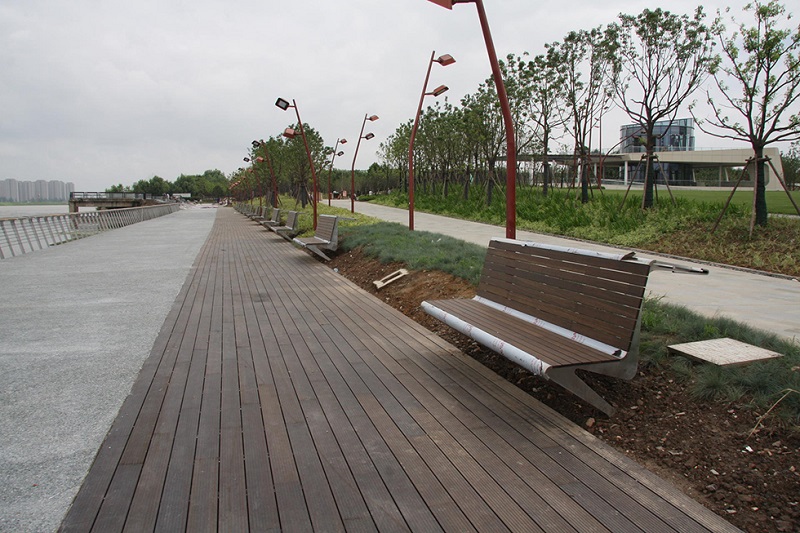
The pattern across recent commercial projects is that bamboo is no longer the alternative material. It is increasingly the baseline against which hardwood and composite get compared. Resort operators like the combination of a dense, splinter-resistant surface and the ability to refinish rather than replace. Parks departments like the documented sustainability, the availability of long lengths for continuous boardwalk runs, and the fact that damaged sections can be swapped without special tools.
That shift is being driven by people who have to live with the results. Facility managers who replaced softwood decks twice in a decade, and who have watched composite surfaces chalk and fade, are the ones writing bamboo into their standards now. The material earned that position by performing in difficult sites, not by being marketed well.
If you are specifying a commercial deck in the next twelve months, strand bamboo deserves a line in the comparison set, with the test data attached rather than a general claim about strength or sustainability. The projects where it does best are the ones where the specification was written carefully, the installation was detailed properly, and the maintenance schedule was set before the deck opened.