Bamboo Plywood vs Birch Plywood and MDF: Which Panel Is Actually Stronger?

What We Are Actually Comparing
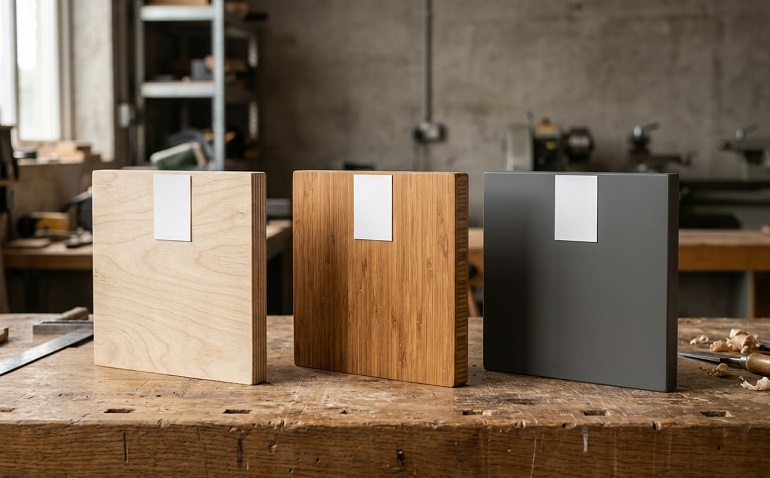
The question of whether bamboo plywood is stronger than birch plywood or MDF sounds simple, but the word stronger hides a lot of detail. A panel can be strong in bending, strong in compression, resistant to impact, or simply dense and stable over time. Each of these properties matters differently depending on whether you are building a kitchen cabinet, a workbench top, a shelving unit, or a piece of veneered furniture. Before drawing any conclusion, it helps to understand what these three materials actually are and how they are made.
Birch plywood is a layered panel built from thin veneers of birch wood, each layer laid perpendicular to the one below it and bonded under heat and pressure with an adhesive. The cross banded structure is what gives birch plywood its reputation for stability and a high strength to weight ratio. It has been the default choice for furniture, cabinetry, and structural substrates in Europe for decades, and it carries a familiar, predictable set of working properties.
MDF, or medium density fibreboard, is an engineered panel made by breaking down hardwood and softwood fibres into a fine consistency, then combining them with a resin binder and pressing them into a uniform sheet under high temperature. The result is a panel with no grain direction, a perfectly flat surface, and a density that sits between lighter particle boards and heavier hardboards. MDF is cheap, consistent, and easy to machine, but it has never been chosen for its raw strength.
Bamboo plywood is the relative newcomer in this group. It is produced from bamboo strips that are flattened, kiln dried, and then laminated together, either in a single direction for a plank like panel or in cross banded layers that mimic the construction of conventional plywood. Because bamboo is a fast growing grass rather than a tree, the raw fibre is remarkably dense and tough, and when it is laminated into a panel, that underlying fibre strength carries through into the finished sheet.
How the Three Materials Are Built
The internal structure of a panel has a direct bearing on how it performs under load, and the three materials here take very different approaches.
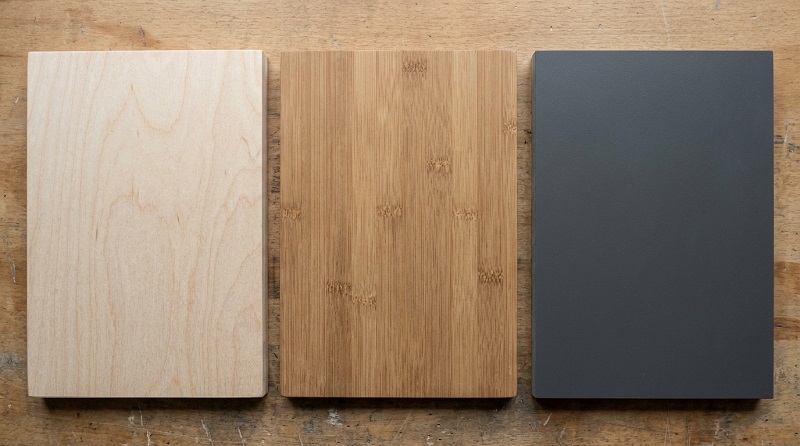
Birch plywood gains its strength from the cross banded lay up. Each veneer layer runs at ninety degrees to its neighbours, which means that the natural weakness of wood along the grain is offset by the layer above and below it. This cross banding resists warping and splitting, and it allows the panel to carry load in multiple directions. The downside is that the panel still relies on the strength of the individual birch veneers, and birch, while a good solid timber, is not the hardest or densest wood available.
Bamboo plywood, when produced in a cross banded construction, shares the same structural advantage, but it is built from a fibre that is intrinsically harder and denser than birch. Bamboo fibres run longitudinally along the length of the culm, and the laminating process preserves that long fibre continuity. Even in a single direction bamboo panel, the longitudinal strength is high because the fibres are long and unbroken. In a cross banded bamboo sheet, you combine that fibre strength with the dimensional stability of cross layering, which is why well made bamboo plywood often posts higher bending and compressive figures than equivalent birch panels.
MDF takes a completely different route. Rather than preserving long fibres, it breaks them down and reconstitutes them into a homogeneous mat. There is no grain, no cross banding, and no continuous fibre length. The panel is uniform in every direction, which is useful for machining and edge finishing, but it means that MDF has no internal structure working in its favour when load is applied. Its strength comes purely from the density of the compressed fibres and the resin holding them together, and that is simply less than what a layered panel can deliver.
Bending Strength and Load Bearing
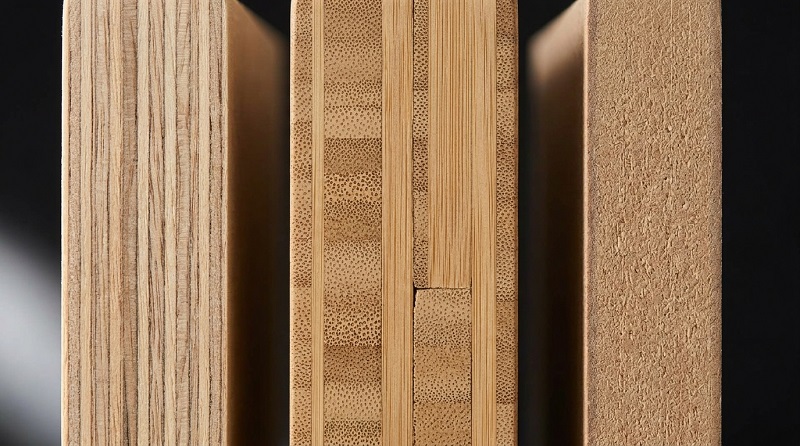
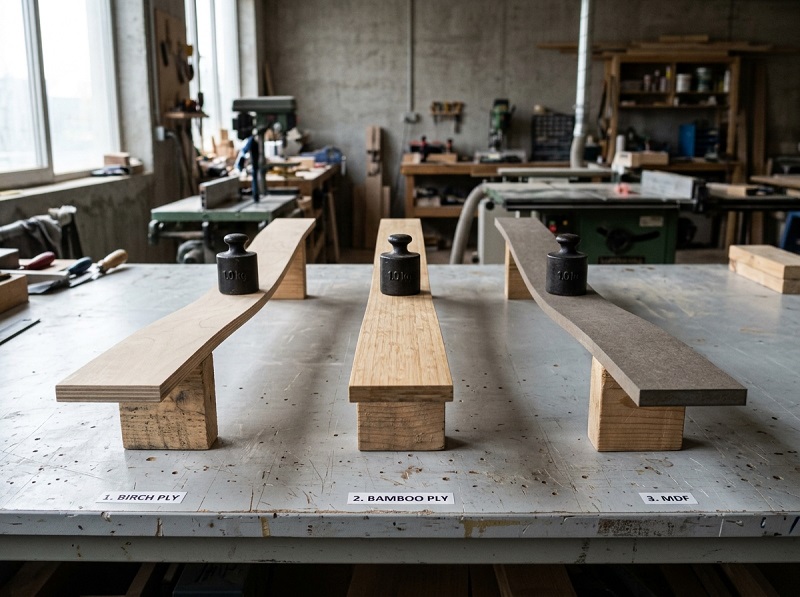
When people ask about strength, bending strength is usually what they have in mind. Bending strength describes how much load a panel can carry before it fails when supported at its edges and loaded in the centre, which is exactly the situation a shelf, a tabletop, or a cabinet side finds itself in.
Birch plywood performs well here. A good quality birch panel, typically built with a waterproof or moisture resistant adhesive, has a bending strength that comfortably supports shelving and cabinetry at standard spans. The cross banded structure distributes stress across the layers, and the panel tends to bend rather than snap under overload, which gives a useful margin of safety.
Bamboo plywood generally exceeds birch in bending strength when comparing panels of similar thickness and construction. The higher density of the bamboo fibre, combined with its natural stiffness, means that a bamboo sheet deflects less under the same load and carries more weight before reaching its failure point. This is one of the reasons bamboo panels have gained ground in applications where stiffness matters, such as worktops, stair treads, and heavy duty shelving. The material feels rigid under hand pressure in a way that birch, while perfectly serviceable, does not quite match.
MDF trails both of them. A standard MDF panel will sag under loads that birch and bamboo carry without complaint, and its lack of internal structure means that failure tends to be sudden and complete rather than gradual. For short span applications with light loads, MDF is adequate, and it is often used as a substrate beneath a veneer where the visible surface is doing the decorative work and the structure is supported by a frame. But where the panel itself is expected to carry load, MDF is the weakest of the three by a clear margin.
Density, Hardness, and Surface Durability
Strength under a static load is one thing, but the surface of a panel has to survive a different kind of punishment. Kitchens, workbenches, and high traffic furniture take impacts, scratches, and abrasive wear, and here the density and surface hardness of the material matter as much as the bending figure.
Bamboo has a natural advantage in this area. The mature bamboo used for panel production is a hard, dense fibre, and the finished panel surface resists denting and scratching better than birch. When you press a fingernail or a sharp edge into a bamboo surface and compare it with birch, the bamboo shows less marking. This hardness is part of why bamboo is specified for flooring and worktops where surface wear is a daily reality, and it carries over into panel form.
Birch plywood has a respectable surface hardness for a timber panel, and it takes knocks reasonably well, but it is softer than bamboo and will show denting and bruising more readily in demanding use. For cabinetry that lives behind doors and sees limited contact, this is rarely a problem. For a tabletop or a frequently handled surface, birch will mark over time where bamboo holds its finish better.
MDF has a smooth, uniform surface that takes paint and veneer beautifully, but the material itself is relatively soft at the surface. A sharp impact will dent MDF, and repeated abrasion can wear through a painted edge surprisingly quickly. The edges of an MDF panel are particularly vulnerable, because the cut surface exposes the fibre structure and it can crush or swell if it takes a knock. In furniture that gets handled hard, MDF is usually hidden behind a hardwood edge or a veneer, and that speaks to its limitations as much as to its versatility.
Screw Holding and Joinery
A panel is only as strong as the joints that hold it together, and the ability of a material to grip a screw or hold a fastener is a practical measure of strength that matters on every build.
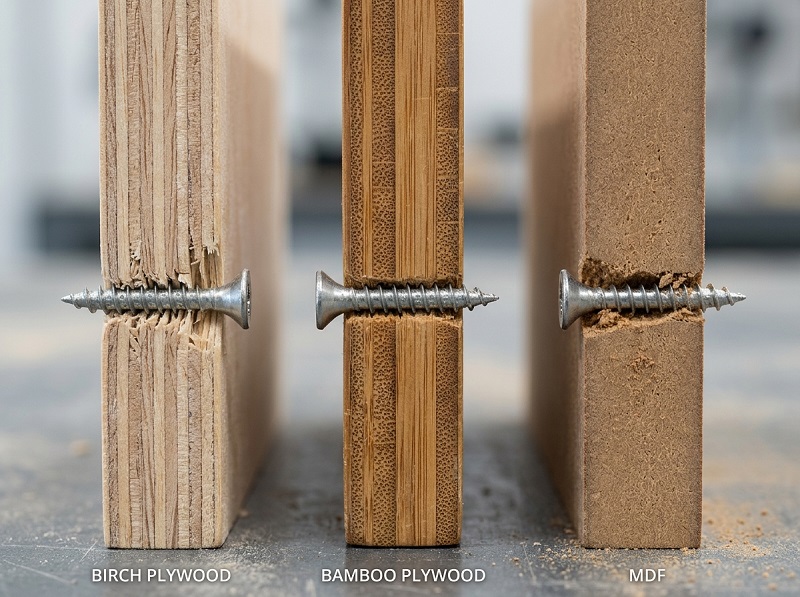
Birch plywood holds screws well. The cross banded layers give the screw threads something to bite into at multiple angles, and a properly sized pilot hole will give a solid, reliable hold. This is one of the reasons birch has remained popular with cabinet makers; it behaves predictably under screws, dowels, and other mechanical fasteners, and it tolerates being assembled and adjusted on site.
Bamboo plywood holds screws better still, owing to its higher density and the tough nature of the fibre. A screw driven into a properly piloted bamboo panel grips firmly and resists pullout, which allows for strong, reliable joints even under load. The trade off is that bamboo is harder to drive into, and a correct pilot hole is essential, because attempting to force a screw into bamboo without one risks splitting the panel or shearing the screw head. Treated correctly, bamboo rewards the effort with a joint that holds fast over years of use.
MDF is notoriously poor at holding screws, particularly at the edges. Because the material is a reconstituted mat of fibres rather than a solid structure, a screw tends to push the fibres aside rather than cutting threads into them, and the resulting hold is weak. Edge fastening into MDF is generally avoided, and where screws must be used, specialist MDF screws with coarse threads, or confirmat style fasteners, are employed to get any meaningful grip. For structural joints, MDF is usually framed with solid timber or used with cam locks and dowels rather than relied upon to hold a screw directly.
Moisture and Dimensional Stability
Strength is not a fixed number. A panel that performs well in a dry workshop can lose a significant part of its stiffness and holding power when it absorbs moisture, so dimensional stability under humidity is part of any honest strength comparison.
MDF is the most vulnerable of the three to moisture. The fibre structure absorbs water readily, and a wet MDF panel swells, loses strength, and never fully returns to its original dimensions once it has expanded. Even humidity swings in a normal domestic kitchen can cause unpainted MDF to move, and a panel that gets genuinely wet is usually written off. This limits MDF to interior, dry, and well sealed applications.
Birch plywood is more stable, particularly when manufactured with a moisture resistant or waterproof adhesive. The cross banded structure resists warping, and birch veneers take and release moisture more evenly than a reconstituted fibre mat. A good birch panel will hold its dimensions through seasonal humidity changes, though it is still a timber product and will move slightly with the environment. For interior furniture and cabinetry, this is entirely manageable.
Bamboo plywood is the most stable of the three under humidity changes. Bamboo fibre is naturally dense and less prone to taking on moisture than softwood, and a well laminated bamboo panel holds its shape and dimensions through conditions that would cause lesser panels to move. This stability, combined with its hardness, is a major reason bamboo is specified for kitchen worktops and bathroom furniture where humidity is a daily factor. It is not waterproof in the sense that it can be left standing in water, but it resists the everyday moisture of a domestic interior better than birch or MDF.
Weight and Working Properties
Strength has to be weighed against weight and workability, because a panel that is strong but impossible to machine or handle on site brings its own costs.
Birch plywood is the most forgiving of the three to work with. It cuts cleanly, sands to a smooth finish, takes edge banding and veneer without fuss, and is light enough for one person to handle a full sheet comfortably. Its predictability is a large part of its enduring popularity; a builder or cabinet maker knows how birch will behave before the first cut is made.
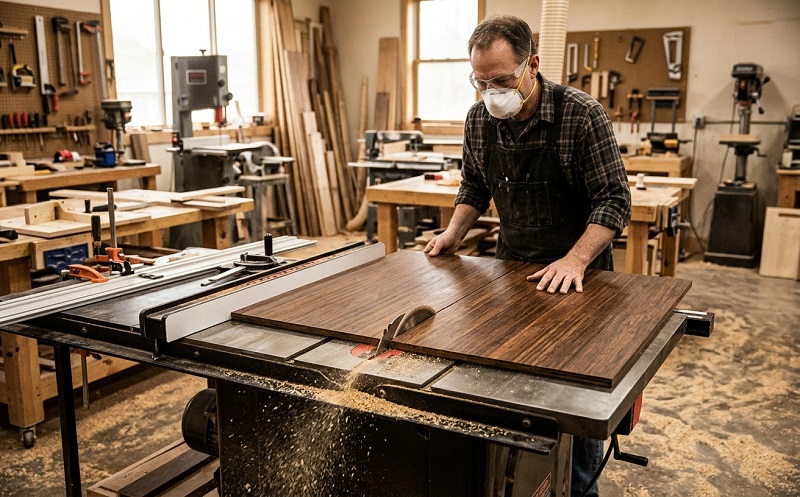
Bamboo plywood is noticeably heavier than birch, reflecting its higher density. It is also harder on tooling, and cutting and routing bamboo will blunt blades and cutters faster than birch will. The material can be splintery at the cut edge, and care is needed to achieve a clean finish without chipping. None of this is a reason to avoid bamboo, but it is a reason to plan tooling and workflow around the material rather than treating it like ordinary plywood. The extra effort is usually justified by the finished result, but it is a real factor in production settings.
MDF is the easiest of the three to machine. It cuts cleanly with no grain to tear, routes to a crisp edge, and takes paint and veneer to a glass smooth finish. It is also heavy for its thickness, denser than birch plywood, and the fine dust it produces when cut is notorious, requiring good extraction and respiratory protection. Its working properties are excellent for painted and veneered furniture, but they do not offset its structural limitations.
Choosing the Right Panel for the Job
None of these three materials is the right answer to every question, and the comparison only becomes useful when it is matched to a specific application.
For cabinetry that sits behind doors, carries moderate loads, and needs to remain cost effective, birch plywood remains a sound, well understood choice. It balances strength, stability, weight, and workability in a way that has served the furniture industry for generations, and it is still the panel most trades reach for when they need a reliable, predictable substrate.
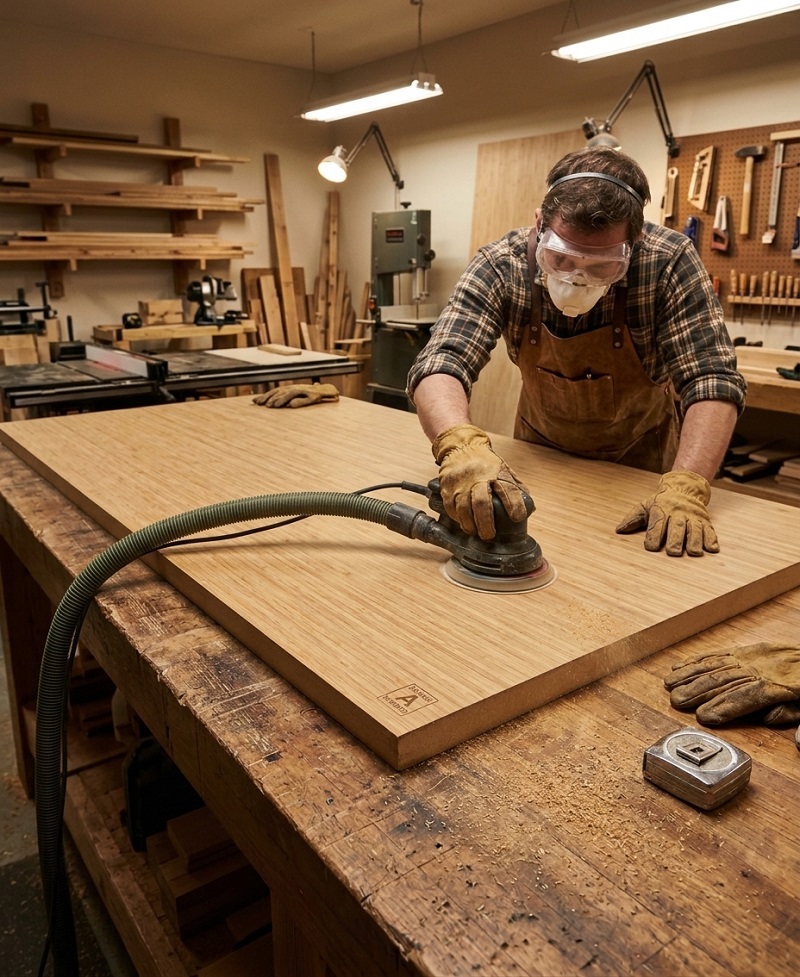
For applications where surface hardness, stiffness, and moisture stability matter most, bamboo plywood offers genuine advantages over birch. Worktops, shelving that carries real weight, stair treads, and statement furniture pieces all benefit from the dense, tough fibre that bamboo brings. The higher cost and harder working properties are the trade off, but where the material is specified for its performance, that cost is usually justified by a longer service life and a harder wearing surface.
MDF has its place, but that place is not in load bearing or impact resistant applications. It is at its best as a painted substrate, a veneer carrier, or a material for profiles and shapes that would be difficult to cut from solid timber. Used within those limits, it is consistent, cheap, and finishes beautifully. Pushed beyond them, its weakness in bending, screw holding, and moisture resistance becomes obvious quickly.
The honest answer to whether bamboo plywood is stronger than birch plywood and MDF is that, by most meaningful measures of strength, it is. It bends less under load, resists surface damage better, holds fasteners more firmly, and holds its dimensions through humidity changes that move the other two materials. Birch plywood is the balanced all rounder, and MDF is the finishing and profiling panel that trades strength for consistency and cost. Choosing between them is less about finding a winner and more about matching the panel to the job it has to do.