Bamboo Decking in Harsh Winters: Extreme Weather Resistance Guide

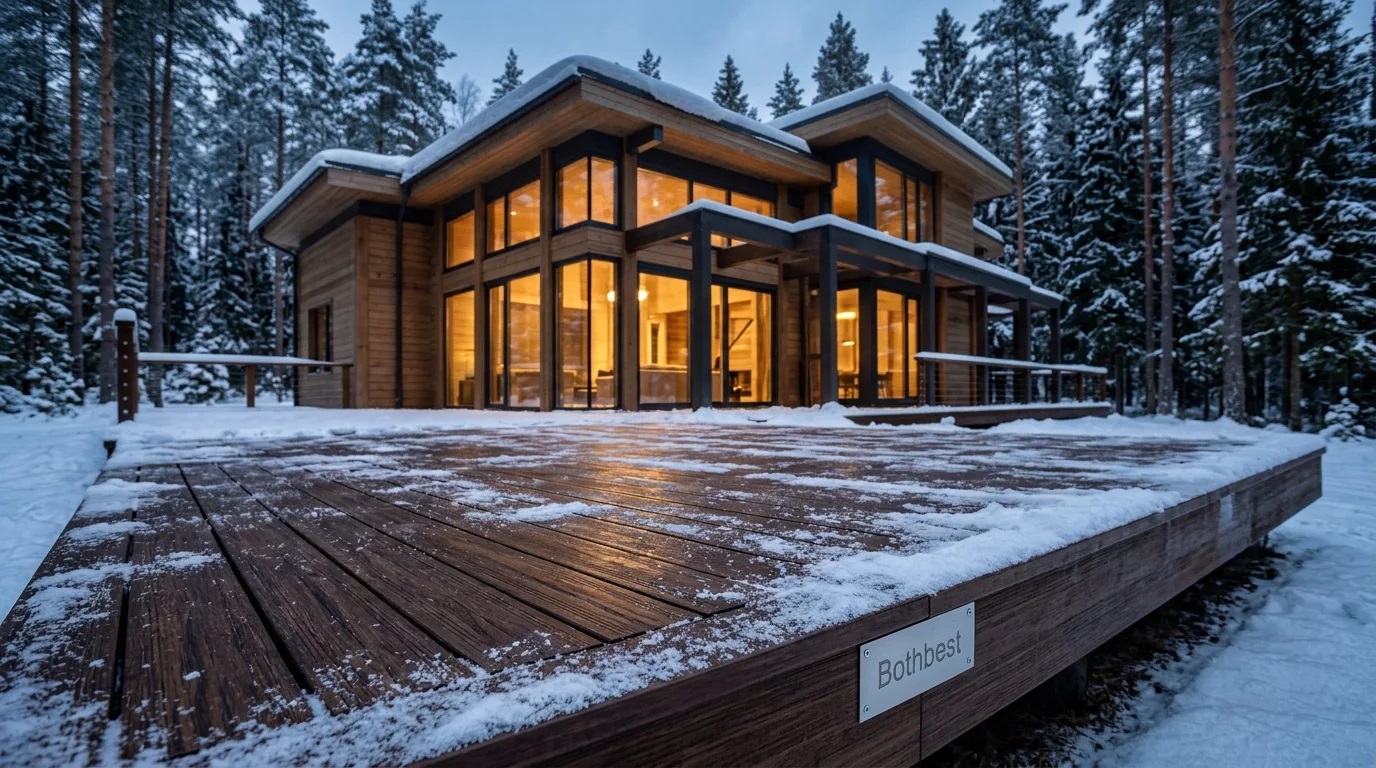
Yes, exterior-grade strand-woven bamboo decking survives harsh winters with sub-zero temperatures down to -30°C (-22°F) without splitting, delaminating, or warping. To perform reliably through repeated freeze-thaw cycles, the boards must be engineered through deep thermal carbonization (180°C to 220°C) and compressed to a density of 1,150 to 1,200 kg/m³ using exterior-grade phenolic resin.
Not all bamboo products belong outdoors in cold climates. Standard laminated bamboo used for indoor flooring absorbs moisture rapidly and swells when trapped water freezes inside its vascular bundles. Exterior strand-woven bamboo decking solves this structural vulnerability by crushing mature Moso bamboo culms into individual fiber strips, removing natural sugars through high-heat steam treatment, and pressing the fibers into an ultra-dense board rated at EN 350 Durability Class 1.
How High-Density Bamboo Resists Freeze-Thaw Cycles
Winter damage on outdoor decks rarely stems from cold air alone. Structural failure happens when liquid water penetrates porous wood cells during daytime thaws and expands by roughly 9 percent upon freezing overnight. High-density bamboo decking prevents this internal hydraulic pressure through two manufacturing processes.
Thermal Modification Removes Nutrients
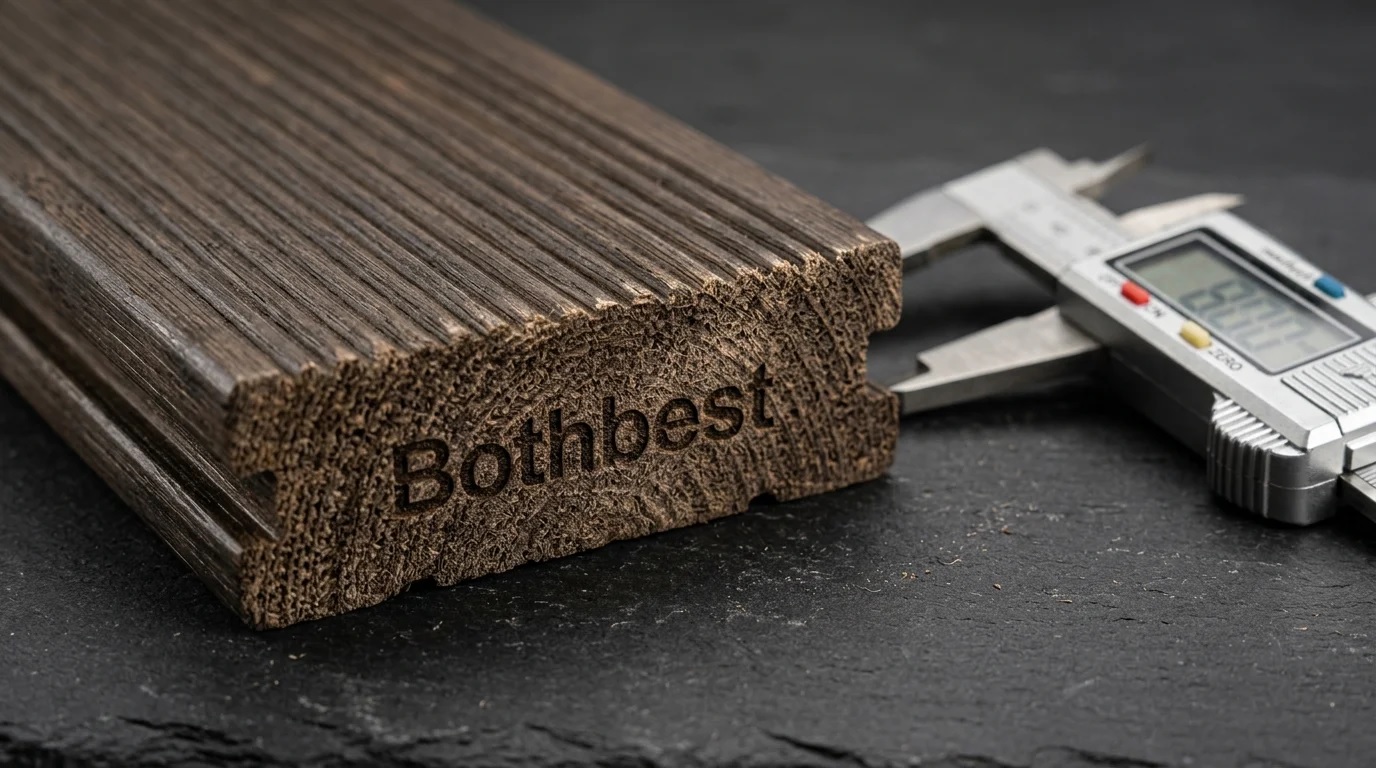
Raw Moso bamboo contains starch, hemicellulose, and water-soluble sugars that attract moisture and fuel fungal decay. During thermal carbonization, stripped bamboo fibers are baked in pressurized steam chambers at temperatures between 180°C and 220°C.
This heat treatment permanently alters the cell wall chemistry. Hydrophilic hydroxyl groups break down, reducing the material’s equilibrium moisture content to between 8 percent and 10 percent. With far fewer moisture-binding sites available in the fiber structure, the finished board resists liquid uptake during sleet storms and prolonged snowmelt.
High-Pressure Compression Blocks Moisture
After thermal modification and phenolic resin saturation, the bamboo strands are compressed under more than 2,500 metric tons of hydraulic pressure. This process collapses the hollow vascular cavities naturally present in raw bamboo stalks.
The resulting board achieves a density of 1,150 to 1,200 kg/m³—nearly twice the density of red oak and comparable to South American Ipe. Because microscopic air pockets are virtually eliminated, surface water cannot wick deep into the core. When tested under EN 15534 cyclic freeze-thaw protocols, exterior strand-woven bamboo exhibits minimal thickness swelling (typically under 1.5 percent after 24-hour immersion) and retains over 90 percent of its bending strength.
Cold-Climate Performance Data: Bamboo vs. Composite and Hardwood
Architects and homeowners in northern regions often compare strand-woven bamboo against capped wood-plastic composite (WPC) and dense tropical hardwoods. While composite boards resist moisture, their polymer shells contract significantly in extreme cold and can become brittle under sharp impact. Tropical hardwoods offer high density, yet irregular grain patterns can trigger surface checking during rapid temperature swings.
| Performance Metric | Strand-Woven Bamboo Decking | Capped Composite (WPC) | Ipe Tropical Hardwood |
|---|---|---|---|
| Average Density | 1,150–1,200 kg/m³ | 950–1,100 kg/m³ | 1,050–1,150 kg/m³ |
| Janka Hardness (ASTM D1037) | 2,800–3,200 lbf | 1,100–1,500 lbf | 3,500–3,680 lbf |
| 24-Hour Thickness Swell | < 1.5% | < 0.8% | 1.5%–2.5% |
| Linear Thermal Expansion | ~0.015 mm/m·°C | ~0.045–0.060 mm/m·°C | ~0.020 mm/m·°C |
| Cold Impact Brittleness | Low (fibrous matrix) | Moderate to High | Low |
| Biological Durability (EN 350) | Class 1 (25+ years) | Synthetic / Class 1 | Class 1 (25+ years) |
| Fire Rating (EN 13501-1) | Bfl-s1 | Cfl-s1 to Efl | Bfl-s1 |
| Slip Resistance (DIN 51130) | R10 (smooth) / R11 (grooved) | R10 | R10 |
Low linear thermal expansion gives strand-woven bamboo a measurable advantage over composite boards in regions with 40°C seasonal swings. A 4-meter composite plank can shrink by 8 to 10 millimeters between July and January, pulling away from butt joints or stressing hidden clips. A strand-woven bamboo plank of identical length moves less than 3 millimeters across the same temperature drop, keeping deck joints tight and stable throughout mid-winter freezes.
Slip Resistance, Snow Load, and De-Icing Rules
Structural durability means little if a deck becomes hazardous to walk on between November and April. Proper surface profiling and winter maintenance habits protect both foot traction and the factory oil finish.
Surface Profiles and Wet Ice Traction
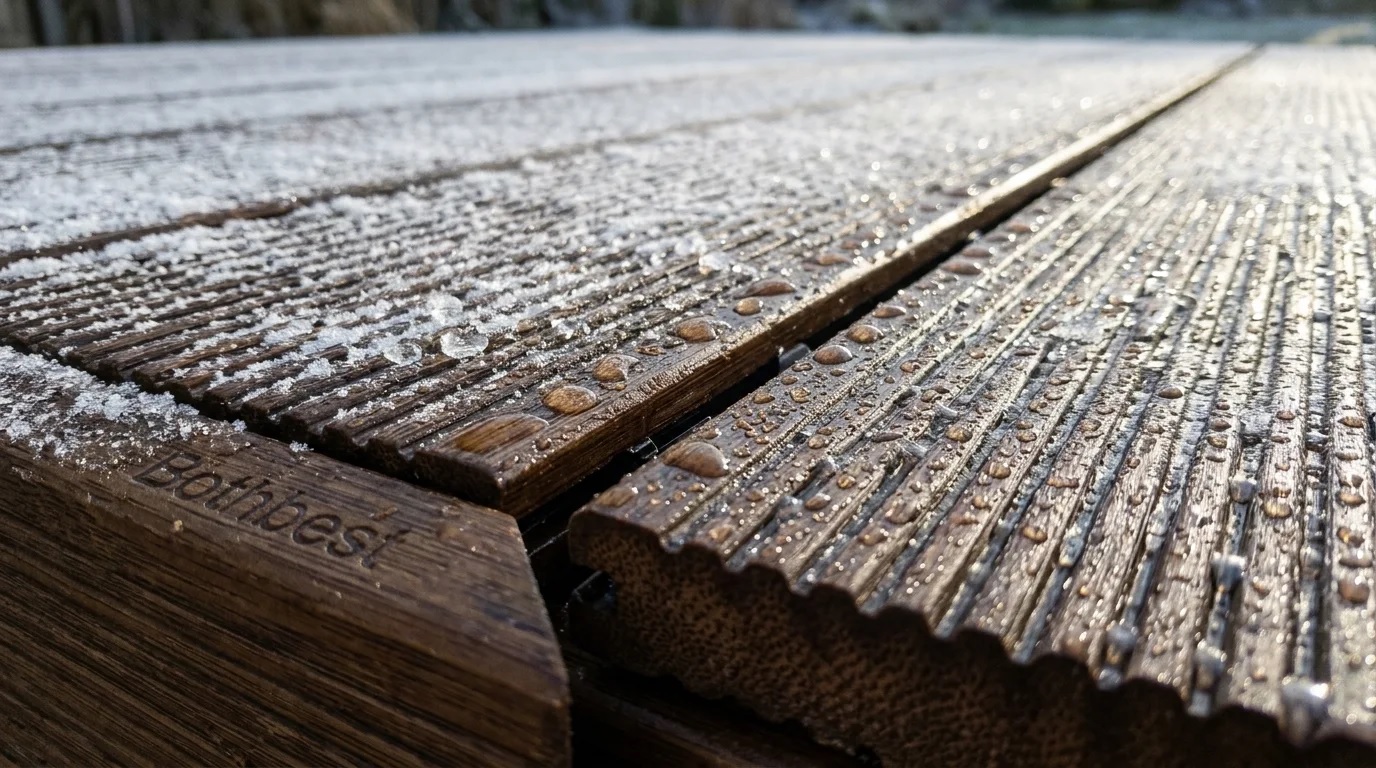
Most commercial bamboo decking boards feature reversible faces: one side milled with fine traction grooves and the opposite side smooth or lightly brushed. In snowy climates, installing the micro-grooved face upward improves wet grip.
Under DIN 51130 ramp testing, grooved strand-woven bamboo achieves an R11 slip-resistance rating, while smooth brushed profiles rate at R10. Fine grooves channel melting snow away from shoe soles, reducing hydroplaning during freezing rain. However, avoid deep, wide V-grooves in areas prone to black ice, as thick ice ribbons can lock inside deep channels and take longer to thaw.
Safe Snow Removal and De-Icing Agents
Clearing snow promptly prevents heavy wet slush from refreezing into thick ice sheets. Follow three strict rules when clearing bamboo planks:
- Use plastic or rubber-edged shovels: Metal snow shovels and ice choppers gouge surface fibers and strip protective penetrating oil, exposing raw strands to moisture.
- Shovel parallel to the planks: Pushing a shovel blade across board edges catches slightly raised corners and chips bevels. Always push snow along the length of the boards.
- Choose non-corrosive ice melts: Calcium magnesium acetate (CMA) or potassium chloride melts ice safely without drying out bamboo fibers or corroding metal fasteners. Avoid rock salt (sodium chloride) and traction sand. Rock salt draws moisture out of the surface grain and leaves white alkaline crusting, while sand acts as an abrasive paste underfoot that wears down oil coatings.
Cold-Weather Installation Standards to Prevent Frost Heave
Even the densest deck board will cup or buckle if installed over a poorly ventilated frame or set too close to freezing soil. Cold-climate installations must account for ground frost heave, snowmelt drainage, and seasonal moisture movement.
Sub-Frame Airflow and Ground Clearance
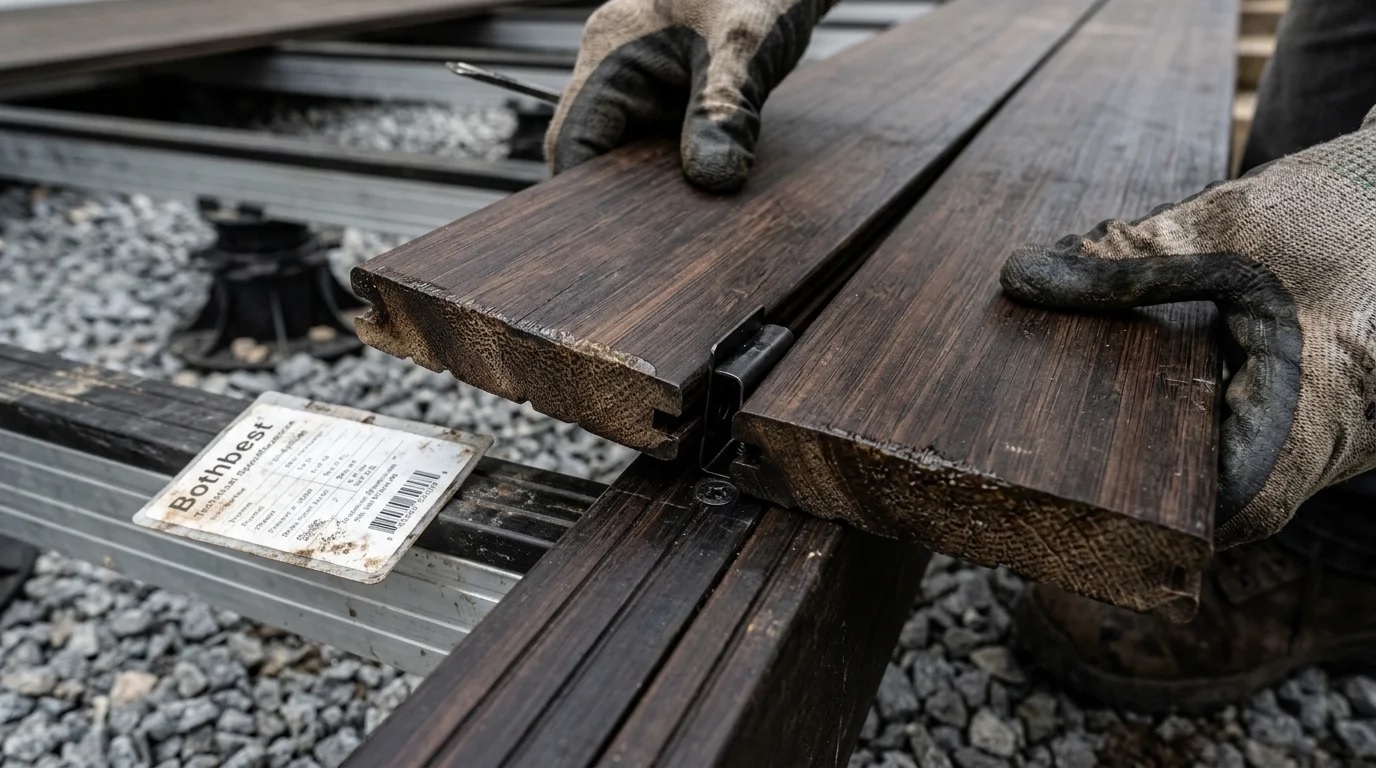
When damp soil freezes, it expands upward. If a ground-level deck sits directly on compacted earth or lacks air circulation, moisture trapped beneath the planks creates a humidity gradient—wet on the bottom face, dry in the winter sun on top—causing boards to cup upward.
| Installation Parameter | Cold-Climate Requirement | Engineering Purpose |
|---|---|---|
| Minimum Ground Clearance | 300 mm (12 inches) | Prevents snowbank contact and ensures cross-ventilation |
| Sub-Frame Drainage Slope | 1.5% to 2.0% away from walls | Sheds snowmelt before overnight refreezing |
| Joist Spacing (On Center) | 400 mm (16 inches) maximum | Supports wet snow loads without board deflection |
| Side Board-to-Board Gap | 5 mm to 6 mm | Allows drainage and prevents ice bridging between planks |
| Butt-Joint End Gap | 2 mm to 3 mm over double joists | Accommodates minor seasonal expansion |
| Fastener Material | AISI 316 marine-grade stainless steel | Resists de-icing chemical corrosion and shear stress |
Ensure at least two sides of the deck perimeter remain open or fitted with ventilated skirting so cold dry air circulates freely beneath the joists.
Expansion Gaps and End-Grain Sealing
The cut ends of any fibrous board absorb water up to ten times faster than the planed face. Before fastening planks to the joists, coat every freshly cut cross-section with a dedicated wax-based end-grain sealer.
Install boards using side-grooved hidden fastener clips made from 316 stainless steel rather than face-screwing through the top surface. Face screws create small entry funnels where meltwater pools and freezes around the screw head. Hidden clips secure the planks cleanly while maintaining an automatic 5 mm drainage gap between adjacent boards.
Seasonal Maintenance Schedule for Freezing Regions
Strand-woven bamboo requires minimal winter intervention, but two brief seasonal tasks preserve its deep espresso color and water-repellent barrier for decades.
Pre-Winter Penetrating Oil Protection
Apply one thin coat of water-repellent penetrating decking oil (such as WOCA Exterior Oil or Cutek Extreme) in late autumn while ambient temperatures remain above 10°C (50°F). Penetrating oils soak into the top 1 to 2 millimeters of bamboo fiber without forming a surface film.
Unlike film-forming varnishes or polyurethane sealers—which crack, peel, and trap moisture underneath during hard freezes—penetrating oils flex with the wood fibers and cause water to bead on contact. Wipe away excess oil after 20 minutes so the surface cures dry and tack-free before the first snowfall.
Spring Inspection and Surface Renewal
Once spring thaw arrives, sweep away fallen needles, leaves, and winter grit trapped inside the 5 mm board gaps so water drains freely. Wash the surface with a pH-neutral exterior wood cleaner and a stiff nylon deck brush. Avoid high-pressure washers exceeding 1,200 PSI, as concentrated water jets can fuzz the surface grain.
If winter sun and snow abrasion have lightened the boards to a silver-gray patina, apply a single maintenance coat of pigmented penetrating oil to restore the warm carbonized brown tone and reset water resistance for the coming year.
Frequently Asked Questions
Does bamboo decking crack in deep freezes?
Exterior strand-woven bamboo decking does not crack in sub-zero weather when properly manufactured and sealed. Its 1,150–1,200 kg/m³ compressed density prevents liquid water from entering the core, eliminating internal ice expansion.
Can you apply rock salt to bamboo boards?
No. Rock salt (sodium chloride) dries out surface fibers, leaves white mineral stains, and accelerates corrosion on hidden metal clips. Use calcium magnesium acetate or potassium chloride instead.
How long does bamboo decking last in snow?
Rated at EN 350 Durability Class 1, properly ventilated and oil-maintained strand-woven bamboo decking lasts 25 years or longer in regions with heavy annual snowfall and freeze-thaw cycles.